Posts Tagged ‘Will Richardson’

A Gr8Tweet-ing Experience

Friday, April 3rd, 2009

Educators new to twitter, here is a little walk down memory lane…

Remember your first days of university? You weren’t sure what to expect and you had to put yourself ‘out there’ to connect to new people?

Do you remember going to a class and not knowing anyone?

Imagine for a moment that you enter, for the first time, a small class and the teacher is trying to start a conversation. When you say something in that class you aren’t really sure who is paying attention… (That’s a Tweet). Someone says something and you respond… (that’s an @reply). The person next to you likes what you said and leans over to quietly tell you so… (that’s a Direct Message). Soon you have the confidence to share your ideas in a bigger classroom… (that’s how you build a following).

You jumped into a new learning environment and made it interesting. You can do that on Twitter too, but just like your new experience at university, you’ve got to put yourself out there, you’ve got to be willing to meet new people, and you’ve got to put some time into making new relationships that can be lasting and meaningful.

It doesn’t work if you don’t try.

It doesn’t work if you aren’t doing it for the right reasons.

But if you are willing to make the effort, you are going to find a community of learners that want to connect to you, and learn from you, and give you more than you could possibly give back.

- – - – -

A little over a month ago, a few of us started a conversation and it grew into Gr8Tweets. For the month of March, we would promote the use of a hashtag (#gr8t) in order to collectively share some of our favourite Tweets in one place. When we came across something we considered GREAT, we would retweet it with #gr8t.

The Gr8t caped Twitter Bird

I really enjoyed planning and launching this with Laura Deacs, Darren Kuropatwa, Sue Waters, Liz B. Davis, Heidi Hass Gable and Bud Hunt. Special thanks as well goes to the many wonderful -people - who - jumped - on - board - with - blog - posts - tohelp - promote - the - idea. And even more thank you’s to those that contributed Tweets to #gr8t.

I think this was a great way to synthesize some of the links and ideas that people share on Twitter every day, and for me it highlighted why Twitter has become such a special part of my PLN. I plan to continue using the hashtag when I find something really worth sharing.

- – - – -

So for those of you that may still be struggling to ‘get’ twitter, check out the resource page on the Gr8tweets wiki. And remember your first days of university. Remember that it takes work and effort to build a meaningful community of friends… and when you decide to join in, put yourself ‘out there’ and give it a fair chance. Once things get rolling, the effort fades and the benefits soar!

November Learning

Tuesday, May 27th, 2008

After my last post I went to hear Alan November speak at an afternoon Pro-D session. I then read Brian Kuhn’s blog post and added a comment, which I have edited slightly and included below. In the process of writing this comment I realized a valuable lesson, which I will discuss below the comment:


The afternoon session With Alan November was great!

It was wonderful to hear Alan November again. His webcast for the district was one of the things that lit a fire under me and encouraged my to explore technology as a means for students to learn ‘new things in new ways’.
This weekend I was listening to some of his podcasts and I wrote a blog post about them : Looking back at it, my reflections were somewhat sarcastic and negative… A product of feeling like things just haven’t been moving fast enough.

Tuesday afternoon changed that for me. There are a lot of great teachers out there doing wonderful things, and there are many more teachers out there feeling overwhelmed by how much there is to learn, who are still willing to take the next step forward. On a more personal note, the world of web2.0 has given me wings , but I realized that I too have a long way to go before I am doing all the things that I can to give my students wings too!

Thanks to Jill Reid for the invitation, to all the leaders who helped make a day like today possible, and to Alan November… I am refueled and ready to continue my journey of learning along with my students.

Here are some notes about today e-mailed to me from Joni, a true leader in our school. She may not be tech savvy (yet), but teachers like her who offer their leadership, guidance and support are what will help ‘us’ move forward using technology ‘for learning’ rather than just using technology to teach!

Great tool: webcast site ‘Jingproject‘.

Suggestions: Kid jobs for the class

1) Answer questions from class. This kid needs to answer all questions, if he can’t, he needs to find the answer on the web, then post the answer.
2) Continuous researcher through class
3) Official scribe: takes notes for the class every day. Post them to the site.
4) Create a Wiki site. Allows children make a contribution to the world. wikipedia, or your own space like www.wikispaces.com [My attempt - ScienceAlive.]
5) Contributing any source that they find on he web to the class: use a social networking site. eg. www.diigo.com create a diigo account for the class or every student has their own account and then “share to group”. [I used delicious and am now moving to diigo]


Teach/Learn

Reflect and Learn

Here is the sentence from above that has hit home with me over the past few days, “the world of web2.0 has given me wings , but I realized that I too have a long way to go before I am doing all the things that I can to give my students wings too!

I currently have a private Ning network for my students, but it is really driven by me! The blog posts, the groups, the forums… all initiated by me! Yesterday I read a post by Konrad Glogowski. The post, “Conversation with Pre-Service Teachers – The Set Curriculum“, was about just that, ‘the set curriculum’ (something I have written about a few times) but a specific section struck a chord with me:

“It seemed logical to me that my responsibility as an educator was to prepare a collection of texts, resources, diagnostic and assessment/evaluation tools in order to achieve specific learning outcomes. I saw myself as a subject expert whose primary responsibility in the classroom was to teach a very specific set of skills and competencies. I saw myself as someone who possessed knowledge and perceived my students as individuals who needed to acquire it.”

I am new to teaching planning 10, and I am trying to launch a specific program, YPI , that I am learning about with the students. So, I did what many teachers do when they are unfamiliar with the curriculum… I teach to it.

In the last little while my posts have been peppered with negative undertones about things not moving fast enough and technology limitations that I have found frustrating. Well, although those things are legitimate concerns, they are things that are for the most part beyond my control. What I can do is create an engaging classroom environment that actually gives my students wings.

Another thoughtful lesson inspired by Alan November , and realized through my blogging/web2.0 experience.

Originally posted: November 23rd, 2007

Reflection upon re-reading and re-posting:

After reading Konrad’s post, I went into my classroom and wrote a forum post for my ning networks titled, “You lead the way“, and this is what it said:

Here is your chance to be the teacher today.
What do you want to learn more about? What questions do you have? What interests you?
This can be about Planning 10 or anything else. It can be questions that you often wonder about or just a thought in your head.
You have 2 choices.
1. Respond to this forum
2. Create your own forum discussion

Feel free to link to other websites. It can be really small ideas or really big ideas.

Then I would like you to read what others have written and join in the conversation.

Some of the student discussion choices were (in my opinion) silly. Others good, and still others were heated, including a thoughtful discussion on the Death Penalty, where I had to bite my digital tongue…and sure enough a student came up with a perspective that I thought needed to be shared. These ‘free’ conversations gave the students some ownership of the site and encouraged a greater amount of online conversations afterwards.

“Release the Hounds” by Chris Harbeck

Sunday, May 18th, 2008

You can go to the K12Online page or to Chris’ wiki page.

To put it simply… there is something here for everyone!

Description
This presentation takes participants along my journey into integrating 2.0 applications and “21st Century Learning” into my pedagogy. The presentation will show how teacher driven assignments and projects teach students some of the skills they need to use these new technologies to enhance their learning. Scribe Posts, Growing Posts and E-Portfolios will provide participants with three different activities to do with their students. The final part of my presentation takes participants into “unprojects”. Participants will learn how to create “unprojects”. For the veteran teacher who is using 2.0 in their classroom this is for you. See how students are more creative and show more enthusiasm towards assignments when they are in charge of their learning.

This is where the future of education should be heading… Kudos to Chris Harbeck!

- – - – -

Unfortunately I will not be participating in the CUEBC Conference with Will Richardson. He comes all the way to my neighbourhood and I have to miss him! Fortunately I am missing this so that I can help out at a Student Leadership Retreat with my school. I have run these camps for many years (and have resources to share). This year I am helping out rather than leading. I look forward to this, and I hope to learn a lot with the advantage of a different (less stressful) perspective. Joni, is a great leader who truly lives by the mantra I borrowed from Dave Sands, “I teach leadership not followship”. I wish I could do both events, but at least I am doing something that I will enjoy and learn from. You can do the same by heading to one of Chris’ links above.

Originally posted: October 18th, 2006

Reflection upon re-reading and re-posting:

It’s all about empowering students to be responsible for their own learning… whether teaching them content in a class, having them explore an area of interest, or having them run a school-wide activity as part of a leadership program.

Chris’s comment on this post said,

Thanks for visiting the presentation. I hope you can use the tools with your students. You will find that when students have creative control over how they present information they rise to new levels of learning. Have fun.

Chris make it interesting

Here is his unprojects presentation:

Two ’stuck’ posts, a borrowed post with an added rant, and a few questions.

Sunday, May 18th, 2008

I have 2 blog posts on the go right now that I can’t get myself to complete.

One is on Digital Citizenship which looks at a post by Vicky A. Davis. The concepts I am formulating are in need of some more deep thought, and I don’t know when I will get to it?

The second post is on a 1-1 project in our district. I invited myself to a presentation for parents of students receiving computers for the project. Although the post is almost done, (and sitting in a Google document), I’m feeling bitter about my lack of availability of computers to teach my Planning 10 classes and so I don’t think I can complete the post until my frame of mind is one that can frame the post in the positive light I feel it deserves. (I feel childish admitting that, but that’s where I’m at right now.)


A third post has been looming in my head, but my feedreader fed it to me in the form of someone else’s post: It’s time for some perspective here by Kelly Christopherson.


Here is a little more perspective: I am attempting to fully engage, but still can’t keep up… I’ve been to Second Life, but can’t find anything useful there… I don’t Twitter (yet?)… and to me Ustream seems like nothing more than a car accident that everyone is slowing down to look at…

All these tools are technological with only the potential to be pedagogical… but they aren’t designed with pedagogy in mind. And so with regards to education, I wonder if those in the lead are actually worth following? Will Richardson has a great blog, but I’m not going to give him and his buddy 45 minutes of my time to get information that a 4 paragraph summary of their talk could give me!

…And as for the big hype around backchannels… why do people think this is something worth having transcribed? If a backchannel is used correctly -in my humble, ‘perspective from the outside looking in’, opinion- then it would influence the presenters, and so the meaningful components would be integrated into the presentation. As for any ‘interesting sidebar conversations’ that happen- they are mostly relevant in context with the presentation and if they are worth expanding on and investigating… great, investigate them and blog them for me, just don’t ask me to read 200+ comments to find a gem in the rough. Backchannels have tremendous value in the ‘here-and-now’, during a presentation, but what’s with all the analysis after the fact? My point is that not only do I not have time for all these new tools, these new tools are time consumers that don’t add to my learning experience in a meaningful way.

Looking at Kelly’s post, he states:

“Primarily, little has changed with education despite all the tools. I firmly believe that until we examine the curricula, change some of those objectives and rework others, making it relevant to the students, no amount of cool tool is going to create change.”

I couldn’t have said it better!


[Pink Floyd tune in my head... clocks ticking/bells chiming] The coordination of the Graduation Transitions Program at our school is consuming so much of my time. I have to be realistic about what else I can do!

  • How much of the K12Online07 conference will I participate in?
  • Is FieldFindr worth spending time on?
  • Am I Ning-ing for my Planning 10 class project or blogging?
  • When will I finish my other posts?

I could go on but I think my point is made, and I want to turn my questions outward…

  • Am I the only one who feels like a 30 hour day would still be too short?
  • Are there others out there who wonder what kind of commitment it will take for a teacher to be technologically savvy enough to meaningfully engage students with all these new tools?
  • Are we focusing too much on the tools and not enough on pedagogy?
  • Will educational structures change fast enough to provide our students with a relevant education?
  • … and for that matter… What would an ideal education look like today?

*Update: What technology should do for us…

Learning Authentically in the Language Arts Classroom by Jamie McKenzie

Here are the bulleted criteria under 1. Rationale …

“authentic teaching” that involves students in “authentic intellectual work” outside school.

…pass the test of authenticity because they meet the following criteria:

  • They are rooted in issues, challenges or decisions that people face in the world.
  • They are genuine.
  • The act of wrestling with these challenges is purposive – saturated with meaning and significance.
  • A student can see a payoff in the future for work well done and skills acquired.

In short, authentic intellectual work passes the test of “so what?” It is meaningful, worthy and generative – in the sense of provoking ongoing growth and development.

I think that if the use of technology is authentic in this way, then the technology is being used appropriately in education. (Rather than just to play with the newest toys, as I seem to be noticing with Ustream- more on this misguided ‘use of technology in education’ in my next post). Also noteworthy, the author’s Anti-Prensky article.

Originally posted: October 15th, 2007

Reflection upon re-reading and re-posting:

In his post, Kelly linked to Stephanie Sander’s post over at Change Agency, which fits well with the quote above that asks (in the last sentence) “so what?”

Stephanie’s post asks “What?, So What? and Now What?” and is well worth the read!

- – - – -

An interesting aside… the 1-1 presentation I invited myself to in October, ended up being at the school I was promoted to in February. I introduced Mr. Mak to wiki’s and this amazing teacher has made the class wiki into a class portal for almost every subject for his class and in some cases his team. Hard to believe that he just got the laptops in February!

More thoughts after the comments…

- – - – -

Comments on the original post:

  1. We must always be willing to innovate. I have found that the backchannel is very useful in my classroom and at conferences. It is not a transcript but a place where people may become involved in the conference — see Diane’s post today about the experience.Yes, there are a lot of things to try out and learn. I think that ustream gives us a couple of capabilities — #1 a live view into a live presentation — sit in if you wish — or check the 4 paragraph blog post later (but does the blog post really contain everything — probably not and #2 instead of an incredible speaker skype videoing into my classroom — why not connect to 10-15 classrooms or more — why should I horde those opportunities.Yes, we’re playing with some of these new tools, but that is what happens on the bleeding edge. I am using backchannelling in my classroom as well as twitter for flat classroom.And no, there isn’t enough time in the day. Just don’t let it overwhelm you and make you cynical about it all. There is a time and place for innovation and it rests squarely where there is room for improvement in the classroom… students need to be a part — not just receivers. That is what the backchannel offers.

    I’d love to answer your questions and share thoughts about these emerging fields. But don’t forget a great teacher will be a great teacher anyway — we all have to do the best we can with where we are — and if you join twitter — let me know. Would love to make your acquaintance.

    Vicki Davis on Tuesday, 16 October 2007, 00:48 CEST

  2. I too share your need for more time. I am a dabbler with these tools and thus my full understanding is stunted by the lack of depth. If backchanneling is similar or actually like the chat that went on as people downloaded and watched Warlick’s pre-conference keynote, then I am in agreement with you Dave. The nonsensical chatter that went on instead of real discussion of the issues being presented drove me bonkers. In fact, it became apparent that few people had actually watched the presentation and were using the conversation like a kiss and hug chat room. Very annoying. Another example was the fireside chat with Warlick…I felt like a kid with ADHD trying to listen to David, watch the whiteboard while being distracted by the chat box. I know that the digital natives are able to multitask, but that was ridiculous. Multi-tasking is another way of saying – hit them with as many mediums as possible and hope one holds their attention long enough to give them information. I say….say something worth saying and you will hold their attention.
    Just my “2cents”…

    Dave MacLean on Wednesday, 17 October 2007, 06:15 CEST

  3. What appears to be opposing views of the last two comments is something that interests me.I see the value in a backchannel! There are many times, as a student, that I wished I had a way to ask questions or clarify my perspective, without interrupting the patter of the teacher. A backchannel could also be used as Vicki is using it, to share what she is teaching with others along with a video stream so that they too have a part in the presentation rather than just receiving it one-way.I also see the caution of throwing more ‘information’ out without it having any pedagogical merit. That was my rant. However, in hindsight, I was to quick to pounce. Educators are now experimenting with tools like Ustream… it is a new boundary teachers are playing with. As I said above, “Backchannels have tremendous value in the ‘here-and-now’”, what I don’t understand is the transcribing of the backchannel. The overanalysis of an unstructured stream of information… it seems like too much. Also, as Dave says above, “say something worth saying and you will hold their attention.” But these are NOT two sides of the same coin. They are two different coins all together. One is about tools, and exploring their potential. The other is about information, and its’ ability to overload a learner. Together these two perspectives offer opportunity and suggest caution. Both are needed.There’s my pair-a-dimes worth!

    David Truss on Thursday, 18 October 2007, 08:40 CEST

- – - – -

In my comment above I mentioned ‘pedagogical merit’ and to be honest, I have been on a bit of a focus in that direction recently. What I really mean by that is finding the right tools and structures for the right job in order to meaningfully enhance learning and engage learners. That said, I think that it is important to read George Siemens post:

Pedagogy First? Whatever.

…Pedagogy is not the starting point of planning to teach with technology. Context is.

…Pedagogy should not even be a consideration during the planning stages of technology use. Harsh statement? Perhaps, but it’s a reality. Few Utopian situations exist where our decisions on how to teach can be based exclusively on pedagogy. Resources, expertise, technology, needs (of learners, educators, society), and funds impact what we choose to do. In a world: context. The mix of multiple, mutually influencing factors determine what we types of technology we select.

…Let’s abandon the somewhat silly notion of pedagogy first and recognize that the choice of technology is driven by many contextual factors and therefore context is what we are evaluating and considering when we first start talking about possible technology to use. Then, after we have selected technology, we can start talking about pedagogy. Pedagogy is just not a practical starting point for deciding the technology we should use.

So the context is more important than the pedagogy. It is more important to design the learning space, to create a learning environment that is friendly, useful and meaningful to the learners, than it is to focus on the content or intended outcomes.

In a recent presentation I did to teachers in our district with 1-1 Laptops, I talked a lot about Scaffolding. Creating structures in your technology/web-based projects that supported student learning and engagement. (I’m reworking this to be in one of my presentations at BLC08.)

So, now this is what I think:

Context‘ is where you start. Scaffolding‘ is the structure(s) we build in order to increase the effectiveness of the technology use. ‘Pedagogy’ is the artful things we do to enhance learning regardless of technology use.

I’m not sure if scaffolding as described is fundamentally different than ‘good pedagogy’, but the term scaffolding suggests that we build something onto the context, rather than just add something ‘pedagogically sound’ to it… whatever that means!

Reflections: Visit Counts, Technorati, Comments and Ego: A Good, Bad, and (almost) Indifferent Post

Wednesday, April 16th, 2008

An honest look at my blog.

Foster City Reflections

The Good: • This site, elgg.net, is not going to be called EduFilter (seems my e-mail wasn’t the only complaint). Elgg is now EduSpaces, a name a number of us recommended – though I bear no claim to my voice being listened to since I also offered a dozen other alternatives.

The Bad: • All my links to the site need changing, this isn’t necessary since elgg rather than eduspaces in the address still works, but I would rather that my Flickr, Curriki, LinkedIn, & other blogs etc. all had my updated links.

The (I wish I was) Indifferent: • My Technorati URL needs to change. THE BIG QUESTION: Why did this bother me?

There are two reasons that I can think of: TIMING and EGO.

Timing:
My blog is getting more attention than it ever has. Some noted bloggers: Stephen Downes, Scott McLeod, Wesley Freyer, Miguel Guhlin, and Vicki Davis (on EdTech Talk ) have all given my Web2.0 Prophecy: an Adventure a plug and linked to it with my old elgg address. This attention has doubled traffic to my site and I thank them for this! Yet I sit here pretending it didn’t bother me that they are linked to my old Technorati address rather than the new one. This leads to the main reason the URL change bothered me…

Ego:
I while back I e-mailed Scott McLeod in response to his top edublogs? post and wrote this:

“As I said in my comment, thank you for doing this and being honest about your interest in your ranking.
I think a significant number people care and don’t admit it, and I admire someone who openly admits it. I haven’t really paid attention to my rank- being new myself- I have had my blog for almost a year, but would consider myself a ‘blogger’ a la Will Richardson for only a few months now. However I have been watching my number of visits and my clustrmap religiously… not the ranking itself, but it shows my concern in the same vain.” [Link (above) added for this post.]

Here comes the honest part: I like to go to my sitemeter and see where people visit me from. I like seeing the dots grow, in number and in size, on my clustrmap… and I like when I see new links in Technorati. Why?

The fact is, that I want to be well read, and I want my blog to be recognized. Scott McLeod says it best at the end of his ‘top edublogs?’ post:

“P.S. I unapologetically admit that I care about my Technorati ranking. Why? Because I’m trying to make change. The bigger audience I have, the more readers I reach directly and the more people I can influence indirectly through those readers. I’m on a mission. Aren’t you?”

So, not only have I mulled over the change in URL, I have also reflected on this blog quite a bit.
After having this blog for almost a year, this is what I know…
Besides my Web2.0 Prophecy post, the posts that get attention are:

1. Square Peg, Round Hole – a collection of other people’s ideas around schools not fitting kids that I have been adding to until recently, now a second post is in the works.

2. Portal Needed to Connect Classrooms to the World: Global Citizens can Share Talents and Skills with Students and the accompanying wiki fieldfindr, (yesterday fieldfindr had more hits than my blog… almost a month after I created it as a mock-up to go along with the post). When will someone make this a reality?

3. The digital native, the digital naive, and the digital divide – among other things, the idea that maybe students of this generation aren’t fully at the digital native stage… yet.

4. Leadership Lesson Plans – found in my files rather than my blog. Thanks mostly to Curriki, these get visited and downloaded a number of times daily. I am glad I can offer these resourses that I have found useful in teaching Leadership.

And in my opinion, the most under-rated post: School 2.0 Participant’s Manifesto – Manifesto’s are big in education and schools2.0 but they mostly focus on the changes needed to the system. Here, I look at the responsibilities of the learner- remember them?… the people we are ‘doing this stuff to‘. (ok, that was a bit cheeky!)

To anyone reading my blog for the first time, Learning Conversations is a post that quotes a lot of my other posts and gives a sense for what this blog is about, and what it means to me.


And now, in case this post hasn’t been self-indulgent enough,
I will reflect a little more on this blog.

The Good:
•Quality. I take pride in my posts and although I still do them primarily for myself, I am keenly aware that I have an audience. This has made me a much better writer… (and it can do the same for students!)
•Recognition. My site is slowly growing in readership. Fear not ‘A list’ bloggers your position is safe, I’m not tilting the blogosphere on its’ head here, but I do consider myself an agent of change, and I will make my world a better place!
•Meaningful dialogue. I have enjoyed the learning conversations that I have had online. I have not been this excited about learning- ever! Was it like this in school for anyone? Not me.

The Bad:
•In-click/Out-click. I am amazed at how ridiculous some of the Google Searches are that lead to my site. For example I have the phrase ‘Webkinz-dot-com’ in a post that happens to touch an image of a (totally unrelated) bridge. 2-5 times a week I get hits from Webkinz (stuffed animal) image searches – Hardly what I would call a meaningful hit.
•Time. I spend too much time on the computer. I can’t keep up with my feedreader. Both reading and writing are slow processes for me. I started highlighting ‘New Voices’ but have stopped recently because I haven’t read any recently. I resolve this by sleeping less, but I can’t keep this up much longer. Who is doing all this well? And what is your secret???
•Comments. I spend a bit of time each week commenting on blogs… continuing the conversation. But I seem to generate very few commenters on my blog. This might be a result of my next point.
•Post length. I am long-winded. Most of my posts are lengthy. Are readers even getting to the end of them? I think it was Vicki Davis who wrote ‘write it, then cut it in half.’ I have to learn to do this… it won’t be easy for me. Even this post is probably too long!
The Indifferent:
•Technorati. It took a few days but I’m over it. I really don’t mind that I am starting over. I will enjoy watching the links grow again. I have never gone to Technorati to see someone else’s ranking and judged their site as a result. In fact, in a comment on Christian Long’s post Stop Blogging Because You’re An Educator I state: “…Warlick and Richardson seem to be more about post-cards than edu-posts.” I’ve noticed that many of the really meaningful posts that I have read recently have not come from the ‘big boys’ but rather the boys and girls- like me – that are in the trenches, trying to make sense of where schools are now, and where they need to be.


Speaking of the trenches, here is a new voice for you (#5 of 7): Read Claudia Ceraso’s The Price of Evolution in your Teaching Practice.

- – - – -

Images: Foster City Reflections and Under The Bridge 2 are both by Peter Kaminski on Flickr.

- – - – -

Originally posted: March 20th, 2007

Reflection upon re-reading and re-posting:

Changes:

So here I am on my 3rd URL, once again messing up my links/Technorati following – I hope this is the last move!

When elgg links no longer worked for eduspaces, (a change I was not expecting), my blog stats took a real blow. I had no way of informing rss readers of the address change. When eduspaces was threatening to close down, that’s when I ventured into the world of self-hosting.

Apology:

In this post I was unfair to David Warlick and Will Richardson. They do so much for edubloggers and also for education, and yet I made some condescending remarks towards them. They may not be ‘in the trenches’ the way teachers are… but they are leaders that are fighting the same war. David & Will, I am sorry for being overly critical and unappreciative of what you have done to lead us.

Comments:

These are the comments on the original post.

- – - – -

  1. Dave,
    I see you’ve been writing up a storm! I know what you mean about the vainness and ego that we seem to grow as we begin writing. I can empathize with the lack of sleep but mine isn’t from the rss or the writing these days! I know how you feel about trying to be read and wondering what is going on. I think, and this is a fairly thin theory, that there are many, many blurkers who read and don’t comment. For both you and I, we have passed that stage and we want to bring about change because we see the great benefit that it will bring. I, too, really liked the Web2.0:An adventure. I just haven’t had time to give you any feedback!! Take care. We’ll have to “link” up one of these days. Take care. Keep writing. And don’t worry about the size of your posts. I’ve gotten past that. If it is worthy, people will read. Your’s are worthy Dave!

    Kelly Christopherson on Friday, 23 March 2007, 00:46 CE

  2. Thanks Kelly,
    I have the same sentiments about your posts. In fact, if you go to the last link in the post above- leading to a Christian Long post, you will find this in my comment, “I got here after reading a post by Kelly (see his comment above). I enjoy reading his posts, but some of them can take 20+ min. to read when I am in the mood to follow the links, and Kelly is very good at making the links meaningfully relevant.” That is why I am having so many issues with my reading. I love hyperlinking to follow certain thoughts and ideas, but it can take so long… this cartoon sums it up:

    cartoon from www.weblogcartoons.com

    Cartoon by Dave Walker.  Find more cartoons you can freely re-use on your blog at We Blog Cartoons.

    **

    Thanks again for your comment!

    Dave.

    David Truss on Friday, 23 March 2007, 03:00 CET

  3. David,
    After our “chat” at Explode I added you to my RSS and looked forward to having time to come back. Here I am. Glad this post is a kind of guide to your blog highlights.

    I agree with you. Your post is long. If I could edit it, I would cut off this bit:

    “Are readers even getting to the end of them? I think it was Vicki Davis who wrote ‘write it, then cut it in half.’ I have to learn to do this… it won’t be easy for me. Even this post is probably too long!”

    Just that. Because those lines are somebody else’s idea in an altogether different blog. They can shine in the original blog. They are not words consistent with the “voice from the trenches” spirit you have built up here, which is precisely what keeps you reading.

    Please do not write in your own blog according to rules you were not consulted to shape up.

    For your stats, I read your post twice (I tell you this because I’m sure Technorati won’t). I like the way you use lines to subdivide your post. They prepared my mind for a new turn in your thoughts.

    Yet, I admit I was totally unprepared to find a link to my blog at the end!

    Claudia Ceraso on Friday, 23 March 2007, 03:09 CET

  4. As a newbie blogger, I share many of the sentiments you express, Dave. However, my main reason for blogging is to express and share my ideas and thoughts, engage others in discussion, and hopefully make change, in my own teaching or in the teaching and leadership of another person.
    However, there is a rock-star sort of film which covers edublogs, and I wish that weren’t the case.

    Miss Profe on Friday, 23 March 2007, 14:53 CET

  5. Thank you Claudia and Miss Profe,Claudia, excellent point. As mentioned above, I will gladly read Kelly’s longer posts or for that matter any long posts when I find one that is worth reading… and often we get pleasantly surprised towards the end of a post. Wink -Also, thanks for the feedback on the breaks/line dividers, I find them useful in shifting my thoughts and it is nice to know that is being passed on the to the reader.Miss Profe, I am not sure if it is possible to blog, as we both do, and not have it change us in a meaningful way… and I’m sure the changes have a positive ripple outward to those we have influence on. Thanks for your comment!

    David Truss on Tuesday, 27 March 2007, 09:46 CEST

The Web2.0 Prophecy: An Adventure

Monday, April 14th, 2008

Originally posted: March 13th, 2007

Reflection upon re-reading and re-posting:

Until now I have been adding my reflection at the end of these re-posts. However, I thought with this post it should come first. Why? Because it is important that I share the date of the original post before quoting other bloggers who were expressing views/moods they may not currently hold.

Of all my posts, this one really seems forward thinking and, well, prophetic. We truly are ‘heading map-less into new, and uncharted territory’. And we really can ‘be the change we want to see in the world’. This can be an exciting time to be an educator… we must remember that even when things are challenging!

- – -

It has been eerie. Unsettling.
I’ve been restless. Dissatisfied.
… and I don’t think that I am alone.

Wesley Fryer is scaring people with Karl Fisch’s presentation “Did You Know” remixed by Scott Mcleod

“Shock and awe” may not be the best formula for conversations and learning. Maybe I need to craft and share a more basic, simple message, and avoid overwhelming people with too many scary statistics and ideas.”

Will Richardson is ‘Stuck’.

“There’s nothing new here, really. I know. What’s new for me at least is that if feels like my lens for all of this is changing. And that’s why I’m stuck as to what to write about here. My learning and classroom learning look very different. I will never enter another physical classroom as a “student” again, and that’s by choice. That physical space just doesn’t cut it. And schools are all about physical space. And control. And content.”

Kelly Christopherson feels stuck too.

“Really, we, as educators, live in a world of dichotomy – where one part of our world is moving so quickly it takes our breath away while the other side hardly seems to move at all. There we are, stuck in the middle trying to somehow bring these two together. Some people are doing a fantastic job while others are so overwhelmed that they stick with what they know, which, we are finding, doesn’t fit with our present students which is causing some serious problems.”

Sheryl Nussbaum-Beach sees schools with more walls than windows. (Read this!)

“Let’s Rethink It
Order and discipline in a time of tremendous social change in the 19th Century. Well, It is the 21st Century and once again it is time for social reformers to rethink the reasons and ways we are educating our young.”

Tangled in the web I find Stephanie Sandifer, who thinks Action Plans are Overdue. She points me back to Sheryl and Will (whom I had already read), as well as Miguel Guhlin, who in turn writes about Sheryl’s post.

Miguel’s post (overall) is more upbeat… yet this paragraph sticks with me,

“At the risk of sounding cynical, here’s a quick response on Saturday morning: Schools fail miserably about instilling democracy in our children…voting, democracy education are distractions from the REAL curriculum schools teach from and about. Democratic values are also antithetical to our schools since they are restrictive, controlled environments…they are top-down controlled, in the “strict father frame” that George Lakoff describes that tolerates no back-talk, no discussion, no questioning. Socrates would not only be drinking Hemlock, he’d be…well, you can only execute someone once.”

Miguel’s optimism comes later when he says, “…let their voices, that of the learners, ring throughout our schools, voices that speak of relevance, authenticity, and human connections…in ways that cannot be denied.”

This sounds like my friend Dave Sands who says ‘it is students who will change education’. But it isn’t coming fast enough, there are too many ‘walls’ denying our students, too many flame snuffers.

This isn’t new. I’ve been here before.
From my first post:

“In a hundred years or so, everyone now alive in the whole earth will be dead – is this not so?”… “It would therefore be possible for the human race to run its affairs quite differently, in a wise and benevolent fashion, in a relatively short time.”

…”And so?”

“The purpose of education,” said Wizard Prang, “is to make sure this doesn’t happen.” …”The purpose of a system is what it does.”

To my first collection of other posts, where I found so many people writing and talking about how schools don’t fit kids: Square Peg, Round Hole… Time and again I am finding myself in these lulls of impatience, frustration and dissatisfaction.

- – - – -

But it is all making sense to me now.
Well, that might be overstating things… but I have found some clarity.
Have you heard of The Celestine Prophecy?

book cover

Well now I give you, ‘The Web2.0 Prophecy’
My little mock-up of the Celestine Prophecy cover

What spurred this comparison on? My thinking can jump around quite a bit, it went something like this:
We are reaching a group consciousness around ‘where we are’ compared to ‘where we should be’ with the use of technology and schools… ‘reaching a group consciousness’ reminds me of the 100th Monkey Effect… actually, this is like a web version of the Age of Aquarius… which reminds me… what were the ‘9 Ideas’ or ‘Agreements’ I read about in The Celestine Prophecy about 10-12 years ago?… No wait, they weren’t Ideas or Agreements, they were… (Google search the book)… ‘Insights’! …(reading) …Wow, I can really see some parallels here!

So, here is my comparison. I will box in the text about the Celestine Prophecy Insights from Wikipedia (http://en.wikipedia.org/wiki/The_Celestine_Prophecy, Monday Dec. 12, 2007 – I’m just realizing that a date is essential when quoting a changeable text). I will then put my slant on how ‘”WE” are progressing through the insights in relation to the ‘WEb’


The Web2.0 Prophecy

THE FIRST INSIGHT . . . A CRITICAL MASS A new spiritual awakening is occurring in human culture, an awakening brought about by a critical mass of individuals who experience their lives as a spiritual unfolding, a journey in which we are led forward by mysterious coincidences.

A New Web Awakening

Thank you to Alan November, Stephen Downes, Will Richardson, David Warlick and others, for leading the way and helping to awaken us.

- – -

THE SECOND INSIGHT . . . THE LONGER NOW This awakening represents the creation of a new, more complete world view, which replaces a five-hundred-year-old preoccupation with secular survival and comfort. While this technological preoccupation was an important step, our awakening to life’s coincidences is opening us up to the real purpose of human life on this planet, and the real nature of our universe.
The awakening to a whole new era.
Thomas Friedman paved the way in print,

World is Flat by Thomas Friedman

and Karl Fisch added his multimedia presentations.
(2020 Vision – A thought provoking look at the future – 15:45)

- – -

THE THIRD INSIGHT . . . A MATTER OF ENERGY We now experience that we live not in a material universe, but in a universe of dynamic energy. Everything extant is a field of sacred energy that we can sense and intuit. Moreover, we humans can project our energy by focusing our attention in the desired direction…where attention goes, energy flows…influencing other energy systems and increasing the pace of coincidences in our lives.
We = Energy
Time Magazine tells us that WE are
Time’s Person/People of the Year.
Time Magazine Cover

Professor Michael Wesch shows US that WE are the power of the web.

- – -

THE FOURTH INSIGHT . . . THE STRUGGLE FOR POWER Too often humans cut themselves off from the greater source of this energy and so feel weak and insecure. To gain energy we tend to manipulate or force others to give us attention and thus energy. When we successfully dominate others in this way, we feel more powerful, but they are left weakened and often fight back. Competition for scarce, human energy is the cause of all conflict between people.

The Struggle for Power: Elitist -vs- Ubiquitous

On the one hand we have Four Eyed Monsters’ video

“Humanity Lobotomy”: Net Neutrality Open Source Documentary

and on the other, $100 Laptops.

- – -

THE FIFTH INSIGHT . . . THE MESSAGE OF THE MYSTICS Insecurity and violence ends when we experience an inner connection with divine energy within, a connection described by mystics of all traditions. A sense of lightness–buoyancy–along with the constant sensation of love are measures of this connection. If these measures are present, the connection is real. If not, it is only pretended.

Web Mavens rather than Mystics

We have the pioneers: Vicki A. Davis has soared, so has Darren Kuropatwa.

We see the potential!
(I had a glimpse.)

- – -

THE SIXTH INSIGHT . . . CLEARING THE PAST The more we stay connected, the more we are acutely aware of those times when we lose connection, usually when we are under stress. In these times, we can see our own particular way of stealing energy from others. Once our manipulations are brought to personal awareness, our connection becomes more constant and we can discover our own growth path in life, and our spiritual mission–the personal way we can contribute to the world.

We are Connected

Personal (public) blogs (with others commenting) rather than personal (private) diaries.
MySpace, FaceBook, LinkedIn, Explode.us, Flickr, YouTube, and personal
connections as described in A Story About a Tree.

- – -

THE SEVENTH INSIGHT . . . ENGAGING THE FLOW Knowing our personal mission further enhances the flow of mysterious coincidences as we are guided toward our destinies. First we have a question; then dreams, daydreams, and intuitions lead us towards the answers, which usually are synchronistically provided by the wisdom of another human being.

THIS IS WHERE WE ARE STUCK!

On the bright side:

We have the Creative Commons;

Creative Commons License

We used to only dream of flying,

Second Life - Zok Flying

and;

We see the potential for providing wisdom to others.

Wikispaces

But we seem to have impediments to our dreams; challenges and limitations that stall our dreams.

All the quotes at the start of this post belong here… they are symptomatic of how (not why) we are not collectively moving forward. This isn’t about blame or excuses, rather it is about recognizing that things are not necessarily FLOWing as well as they could.

- – -

THE EIGHTH INSIGHT . . . THE INTERPERSONAL ETHIC We can increase the frequency of guiding coincidences by uplifting every person that comes into our lives. Care must be taken not to lose our inner connection in romantic relationships. Uplifting others is especially effective in groups where each member can feel energy of all the others. With children it is extremely important for their early security and growth. By seeing the beauty in every face, we lift others into their wisest self, and increase the chances of hearing a synchronistic message.

THIS IS WHERE WE NEED TO BE NOW!

We need our ‘guiding coincidences’ to be ones that are nurturing and powerful.

We need to collaborate, empower one another, and see potential rather than roadblocks. This is important for our children/our students, but it is equally important for us. Our ’synchronistic message’ can’t be “impatience, frustration and dissatisfaction” as I mentioned earlier.

Our message must be uplifting. But an uplifting message isn’t enough!

We need financial support, visionary leaders, moral compasses, inspiring role models, enriching professional development, and meaningful collaboration. We also need minimally restricted content and unlimited access… these are all building blocks that ‘increase the frequency of guiding coincidences’… these are the things that inspire us, fuel us, connect us, and allow us to see the potential in ourselves and each other. We truly can ‘Be the change we want to see in the world.’

- – -

THE NINTH INSIGHT . . . THE EMERGING CULTURE As we all evolve toward the best completion of our spiritual missions, the technological means of survival will be fully automated as humans focus instead on synchronistic growth. Such growth will move humans into higher energy states, ultimately transforming our bodies into spiritual form and uniting this dimension of existence with the after-life dimension, ending the cycle of birth and death.

Web3.0 or Web3D

Gary Hayes has some ideas about where are we going next.

This is both a scary and an exciting time… but mostly it’s exciting

Reading what I have said regarding the Seventh and Eighth Insights, I am keenly aware that some of us are not ’stuck’, and that some of us are experiencing those ‘guiding coincidences’ where everything is coming together. However, I think currently this is the exception rather than the norm

My question to you is this: When we are stuck, when things aren’t coming together, when our universe is not unfolding as it should, how do we make things FLOW?

I ask this since we are heading map-less into new, and uncharted territory.

Portal Needed to Connect Classrooms to the World: Global Citizens can Share Talents and Skills with Students

Sunday, April 13th, 2008

Originally posted: February 21st, 2007 [Update: Fieldfindr on Ning-October 3rd, 2007]

Here is an idea that has been brewing in my mind for a while:

FieldFindr
A space where teachers can meet global citizens who have skills that they are willing to contribute to a class.
Teachers can find people in a field of interest that they are working on in their class.
Volunteers can tell teachers their field of interest and also tell teachers how they would like to help a class.

The site could be sort of a combination of Warlick’s HitchHikr and MySpace or Facebook. (In a way it is more of a matchmaker site.)
You can sign up and log in as a teacher, or as a willing contributer (Volunteer) in you field of interest.

Basically Volunteers create a profile listing talents and skills. Then they set up a time-line of when they would be interested in helping with, or presenting to, a class. Then teachers can contact volunteers who have profiles of interest.

There could be an opportunity for volunteers to contact teachers too, but I think this should be done through a contact page like this, rather than by direct e-mail.

Here is a mock-up wiki that I built to give you an idea of what I mean. (Yes, I know the profile pictures are a bit big, but they were easy to format that way.)

Wikispaces

Below the mock-up profiles, I created a space where interested contributors to a classroom could actually post their information. Teachers can find prospective volunteers by searching a particular field/subject.

However, I believe that there is a need for a fully committed portal site that is dedicated to:
CONNECTING TEACHERS TO GLOBAL CITIZENS THAT ARE WILLING TO SHARE THEIR TALENTS WITH A CLASS.

At a dedicated portal:
Tag searches could easily be set-up. (See my ‘Super Tags’ post [coming soon])
Teachers could find other teachers to help them.
Positive relationships between business and education can be formed.
Success stories could inspire teachers hesitant to explore web2.0
Retired teachers or field experts can be tapped into.
There is so much opportunity for collaboration! (I came up with this list in about 3-4 minutes… and I’m sure you could add to it:-)

Once the site is set up, the opportunities and possibilities are endless!
Again, just off the top of my head, here are some kinds of volunteers we can easily tap into…Especially if we had a portal to help us do so.

• A musician or poet who is willing to judge a performance or contest.
• A Researcher willing to share new ideas in their field.
• A Math tutor who offers after school assistance on a forum. (Time differences could actually be an advantage here.)
• A dance instructor could teach ballroom dancing at a local high school.
• A retired teacher giving a video tour of a Boreal Forest or a desert he lives close to.
• An art gallery tour from half-way around the world…

- – - – -

A similar idea originally came to me a few years ago after seeing this award winning Timebank Commercial.

It came to me again a few months ago when I read this David Warlick Post where David is talking about Will Richardson’s session at MASSCUE:

“Will did make a passionate point about how we need be talking about sharing our students’ work with real audiences. It’s engaging them in real conversations with the world they’re learning about.

I finally had to get this idea out after reading these Wesley Fryer and Vicki A Davis posts over the weekend.

Feedback?

Originally posted: February 21st, 2007

Reflection upon re-reading and re-posting:

So, in reflecting on my blog posts I move from an unsuccessful book club to an unsuccessful portal… they would be disappointing if they weren’t so enlightening! To this day, failures are looked upon as negative as opposed to opportunities for learning. It seems conditioned into us at such a young age… this is a comment on our society as much as it is a comment on schools.

This is still a great idea… but it was DOOMED TO FAIL! Why?

1. Because it is geared to educators, not to those who would be willing to contribute. My audience and the target audience are not the same. Also the structures to build a sortable ‘bank’ of volunteers are not available for those interested in signing up, (see #3).

2. Formal measures around safety need to be hammered out. Note Kelly’s Comment on the original post:

Dave, I like this idea. I think that it has great potential. Now, the administrator comes out in me but how do we ensure that: a. The person is an expert in what they say they are b. They are safe c. There is not “inappropriate” contact between people and the students.

I think this is wonderful and we have this type of thing going on in our school with some of our local people. The big difference is that we are in a small community, people who are vounteering must do a criminal records check and any outside school projects are to be okayed by the parents. Precautions. I think that this would be an incredible way to get people from different sectors involved in the education system. This would also allow teachers to have references for their projects or assignments – would give validity to what we do in schools. That would increase the “price of stock” for educators in all areas.
3. Both Wikispaces and Ning are the wrong venues, I simply don’t have the required tech savvy-ness or financial resources (or for that matter time) to create what is needed.
- – -
That said, I can see a University really taking this on as a project. They can start with one department, say Music or Science, and promote the interests of their instructors/Masters Students/PhD students with teachers that may be interested in their skills as either mentors or experts or judges or…
There is significant need and opportunity for such a portal and I challenge anyone with the knowledge and resources to make it happen!

Learning Conversations

Tuesday, April 8th, 2008

Learning Conversation_ Part I

It was refreshing to hear Maureen Dockendorf, our staff development co-ordinator, (Director of Instruction), speak at our Building Leadership Capacity (BLC*) series introduction.

She encouraged us to become ‘intellectual companions’ that enter into ‘learning conversations’. The part I liked most about her talk was the direction of the conversation. She spoke of:
Not the Knowing, but the Process of Inquiry.
Not covering the curriculum, but ‘uncovering’ the curriculum.
A focus in innovation and creativity… how do we model this… every day?

Maureen also spoke of the 5 needs that we (students/teachers/learners) have:
The need to feel confident,
The need to feel like we belong,
The need to be potent- feel you have made a difference,
The need to feel useful, and
The need to have a sense of optimism.

(She identified her source for this, but I didn’t write it down.) ["The reference to the needs of the 21st learner were from the former president of ASCD , Martha Bruckner." -Thanks for passing on this information in your comment Maureen.]

I think that when using technology in the classroom, it would be prudent to keep these needs in mind!

- – - – -

Learning Conversations Part II

I started by saying Maureen’s presentation was refreshing. I think I felt that way because when I look back at my blog, I can see parallels to what she spoke about. I think that it is significant that the Director of Instruction in our district is prioritizing these ideas when talking to teachers interested in leadership… especially as more and more pressure is being placed on districts to perform well on standardized tests. So here is my take on what Maureen said relative to what I have written about, (here in this blog so far). Also note my Meta-Analysis of these two parts below.

Not the Knowing, but the Process of Inquiry:

Student leader writing in a Reflective Journal

Articulate your Thinking
The BIG IDEA:
One overall school goal of”Articulate Thinking”.
Building the skills necessary to develop articulate students who can express their thoughts in meaningful, articulate ways.

The Philosophical Bent:
I don’t really care if my daughters, upon graduation, can identify the subordinate clause in a sentence or if they can tell me how to find the volume of a cone… I do care that they can express themselves in thoughtful, meaningful ways and demonstrate social responsibility in their decision making.

Sharing and Engaging: Web 2-point-0h-Yeah!
Vanja both wanted, and demanded a learning conversation. For me it was wonderful to see a student expecting more from her peers, or should I say, from her community of learners.
Reflections:
From Cynthia, “I learned more by sharing than by searching.”
From Mona, “You actually get to learn with each other and help others learn.”
From Lily, “It was fun doing this project and I enjoyed this kind of learning experience when you get to find your own knowledge rather than laying it all out for you. I feel that I have achieved something really good each time I’ve found some interesting facts on the blog and the dialogues, which made me put more time into these things. I realized that this could be another way of learning new things and also communicating with each other rather than finding information by yourself.

“How do you know when your students are learning?… When they are asking the right questions.

“the use of blogs to learn not just to teach”
I need to ask myself:
‘Am I adding technology to my teaching or providing students with new learning and new ways to learn?’
‘Am I creating an environment where students will express, synthesize, and reflect on their (and each other’s) learning, or am I creating a new way to report out?’ (A glorified poster board).
‘Am I encouraging students to be lifelong learners?’

A side note: The curriculum does not come up in my line of questioning… it seems almost insignificant in this meta conversation. Does it matter what the content is, or isn’t the process far more important?

I think that if we want students to be lifelong learners, and we want them to take ownership of their own learning to any extent, then subject discipline must be, at the very least, ‘loosened’ up. [Which leads us to...]

Not covering the curriculum, but ‘uncovering’ the curriculum:

Ripples

David Warlick’s K12 Online Conference Keynote (Derailing Education)
“This is why the foundation of education systems today should not be the rails, but it should be the side trips. It should not be the central standard curriculum, but it should be those directions that students, that learners, both teachers and students, can navigate to on their own.” (David Warlick)

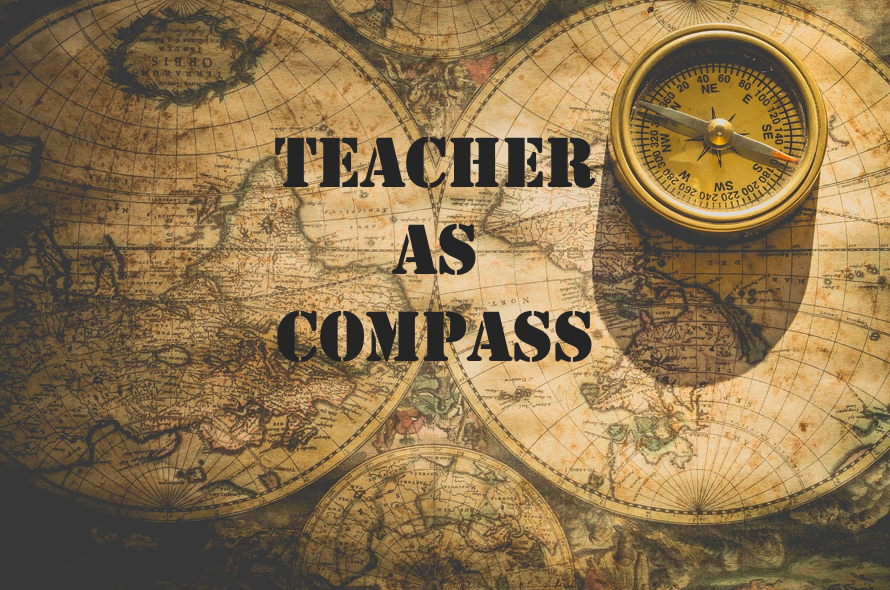
…the teacher as the compass. We point in a direction, (not necessarily the direction that the student is going), and we are a reference point or guide to the learning. As students sail (rather than ride the rails) they must choose their destination, (what they want to learn), and tack and adjust their path as they go… using the teacher as a compass that keeps them on their ‘learning’ course.

The way of the teacher is a practice in trust- (Stone Soup)
“In keeping with “the Stone Soup” metaphor, the teacher brings the cauldron, builds the fire, puts the “magic” stone into the boiling water and trusts that eventually the audience will engage enough to bring their own hidden ingredients to the process.” (Mia Lobel, Michael Neubauer, Randy Swedburg)

Christopher D. Sessums :: Competing Paradigms and Educational Reform
(Linked above to his post, not my short exerpt)
The crucial elements that will sustain school improvement is not high-stakes testing, standards, or reactionary accountability programs – “it is simple human trust… that rests on four supports: respect, competency, integrity, and personal regard for others” (George 2006). “
In terms of education, the alternate paradigm acknowledges the following broad perspective:

  • Curriculum is best derived from the needs and interests of the learners.
  • Developmental appropriateness should supersede national assessment.

“The developmental needs for learners are widespread and cannot be easily or meaningfully reduced to a pencil-based exam.”

Articulate your Thinking (again, but this time from Gary Kern)
I would differentiate all learning, but I would try to cluster learning objectives so that teachers can continue to play a crucial role in learning and still be the main facilitator for learning. The computer, in its ideal form, is the tool that allows us to individualize student work. It will allow us to communicate in real time, learn in real time, and assess in real time. It will be the lever to better learning. Teachers, however, will need to be better than ever before. They will be the fuel for the flame.

…Teams of teachers would still work together to deliver the curriculum, but the interaction and model would be much different than today. Some genius will lay out the curriculum into standards and objectives that are clear and easy to follow. Teachers will bring the objectives to life, and technology will allow students to demonstrate their learning in ways unimaginable only a few short years ago. Problem based learning and rich task learning will be for the masses.

A focus in innovation and creativity… how do we model this… every day?

Bloom's Taxonomy (Revised)

Square Peg, Round Hole
Sir Ken Robinson, Ted Talks: Do schools today kill creativity? (Worth watching again!)

Many of the Square/Round Peg Students (that don’t fit into our other-shaped schools) are the future thinkers/dreamers/innovators that are going to meaningfully change our world. We need to recognize their future value… We have an obligation to nurture them, and to develop their enthusiasm for learning. It isn’t just about not stifling creativity or not making schools so alien… it is about creating an environment where every child can thrive… Not making the misfits fit, but rather helping them create a space that fits them.

Application of Constructivist Principles to the Practice of Instructional Technology

  • Think in terms of designing learning environments rather than selecting instructional strategies. Metaphors are important. Does the designer “select” a strategy or “design” a learning experience? Grabinger, Dunlap, and Heath (1993) provide design guidelines for what they call realistic environments for active learning (REAL); these guidelines reflect a constructivist orientation:
    • Extend students’ responsibility for their own learning.
    • Make learning meaningful.
    • Promote active knowledge construction.
  • Think of instruction as providing tools that teachers and students can use for learning; make these tools user-friendly. This frame of mind is virtually the opposite of “teacher-proofing” instructional materials to assure uniform adherence to designers’ use expectations. Instead, teachers and students are encouraged to make creative and intelligent use of instructional tools and resources. (Bonnie Skaalid)

Synthesize and Add Meaning [To some extent, this fits in the above two categories as well.]

“High expectations are important and needed, but not within a rigorous environment that does not encourage differentiation and flexibility within classrooms. Learning is inherently a dynamical process, not isolated events that can be entirely centrally planned, and our educational language as well as policies should recognize this. We need to embrace differentiation, flexibility and high expectations for all students.” (Wesley Fryer)

But there is a dichotomy here: Our ‘educational language’ around standardization and accountability juxtaposed with differentiation and flexibility… we seem to have two mutually exclusive camps, yet there seems to be a move to embrace both. To embrace both is to accomplish neither.

We need to be adept at creating flexible, differentiated learning environments.

We need to be computer literate, and also be able to teach a new kind of literacy. (Warlick)

We need to challenge students by asking questions, guiding their learning, and helping them to develop their own personal learning environments.

We need to teach students to synthesize information and add new meaning.

We must change what we do. (And we need visionary leaders to lead the way!)
“We need visionary educational leadership that understands and effectively communicates the importance of emphasizing student CREATIVITY and the creation of original (and remixed) knowledge products.” (Wesley Fryer)

A Story About A Tree
…This started out as a story about a tree, and it will end with the planting of some seeds…

How will we use the community building aspects of the internet to foster learning in schools?

How do we make schools into ‘modern day’ learning communities?

How do we get students to engage rather than escape?

- – - – -

Meta-Analysis: Hyperlinks fuel the fire


Campfire


At first, this post was going to be a short reporting-out of my BLC meeting, or more specifically Maureen’s talk. Then I reflected on her words and created Part II, which was going to become this post… but the process of creating Part II ‘planted the seed’ for this post to evolve as it has.

In creating Part II, I tried to put enough information into each section that it really wasn’t necessary to follow a link unless the reader had a personal interest in the specific topic. The ‘effort’ to create this section, in itself, was a meaningful learning experience. Searching for relevant connections and following the hyper-linked-thoughts transformed the post from a simple learning conversation to multiple learning conversations… it allowed me to synthesize ideas and add meaning to the words that I originally heard at the meeting. It took hours to do this, but it was worth it – I became a participant in the learning process – I created internal learning conversations and expressed them externally here.

How does the presence of hyperlinks change the experience of this post for the reader? I can answer that for myself having been consumed by my own reading of edublogs over the past few months. The challenge I now face is being selective on which hyperlinks, which side trips, I choose to go down… this is proving to be a skill that I am learning/honing… but the decision-making process has more to do with personal interests than a logical/deductive process. In keeping with the theme of this post, the act of effectively following hyperlinks is in and of itself a process of inquiry, it requires taking tangents from the curriculum and seeking to ‘uncover’ what is interesting, and it requires the participant to creatively select (personal) relevance. Teaching this skill will be a challenge… one that cannot be measured by standardized tests, but will be a necessary skill for the 21st Century.

Feb. 5th… I have to add hyperlinks to this section! Jesse Lubinsky from Irvington School District in NY sent a video link to Jennifer Cronk. Her post was picked up by Will Richardson who is in my Netvibes feedreader. The video is from, “Digital Ethnography @ Kansas State University“. It is a fantastic video that exemplifies how web2.0 is changing how we connect, what we do… and who we are. I have tried to ’say’ things on this video… it doesn’t just speak what I have tried to say, (a number of times on this blog), it breathes it!

Digital Ethnography @ Kansas State University

- – - – -

*What is the BLC series?
The Building Leadership Capacity series is open to teachers interested in both formal and informal leadership. The four sessions will focus on inquiring and exploring the building of personal leadership capacity through a variety of experiences. The series puts a high priority on opportunities for participants to talk about leadership, bringing the unique perspective of a diverse group of educational professionals together in one room (using the School District Learning Team model**).

**What is a Learning Team
Learning teams are small groups of educators that meet to engage in a professional growth experience focused on improving instructional practice and student learning. Learning teams are facilitated by a variety of educators who have expertise in the topical/curricular area, and in facilitation. Two to three hour meetings occur six times in the year and take the following format: individual write, sharing, discussion, work-time, reporting back and a commitment for the next meeting.
Learning teams offer an opportunity for teachers to meet in a meaningful learning environment. My last post on Articulate Your Thinking came out of a conversation in a learning team. They are an innovative approach to Professional Development in that they provide teachers with an opportunity to engage in ‘learning conversations’ that we want to have, but never seem to be able to find the time to have!

Originally posted: February 4th, 2007

Reflection upon re-reading and re-posting:

I won’t add anything here… at this time. I’ve already done a meta-analysis and the idea behind this post will be developed further for one of my presentations at Alan November’s BLC08.

Maureen’s Comment on my original post:

I have greatly appreciated your meta analysis and the potential for deep and thoughtful conversation based on your writing. The reference to the needs of the 21st learner were from the former president of ASCD, Martha Bruckner. I continue to ask myself how to replicated the level of engagement of the skateboarders into who we are as teachers, administrators in schools?

“the use of blogs to learn not just to teach”

Saturday, April 5th, 2008

Will Richardson’s post Teacher Bloggers Not Blogging (Says Me) looks at the David Warlick article in EDTECH titled Blog Rules. Yet another reference I have found recently to Principal Dr. Tim Tyson and Mabry Middle.

Will says:

“Blogs are powerful communication tools. Blogs are powerful publishing tools. But blogging (the verb) is still much more than that to me. Blogging, as in reading and thinking and reflecting and then writing, is connecting and learning, neither of which are discussed in the article. (And maybe they weren’t meant to be, I know) I’m not knocking what Tim or his teachers are doing, I think it’s great. But I’m just asking the question: how are his teachers modeling the use of blogs to learn not just to teach?”

I have been looking beyond just blogs and considering the use of technologyto learn not just to teach’ quite a bit recently. Is it a natural progression to use technology to teach first then to learn, as we integrate new technology? Or is this just a lack of training and professional development? I’ve heard more than a few people call the new Smart Boards nothing more than glorified blackboards recently, (I have yet to actually even see one of these, much less know how teachers/students are using them, so I am really just making note of what others have told me). The fact is that technology such as this needs the user to be trained. How can we implement new things in new ways if we lack the knowledge or training to do so? Also, I think teachers must model what they expect, or at least find appropriate models for students to follow. A blog that replaces a daily diary may be useful, but does it expose a student to the potential a blog has as a reflective, synthesizing, learning space?

On the topic of blogs, I have been thinking about what this blog means to me. I write it as if I have an audience, but I write it for me, not the audience. It is sort of a cathartic expression of my thoughts on education; A place to synthesize ideas and reflect on new areas of exploration. I am surprised just how often I look back at my entries, reread them and follow the links. It has also been an experimental playground where I have learned a bit about html, and figured out how to add tools, such as the meebo messenger, the ClustrMap, as well as the flikr and bubbleshare photo windows. This blog isn’t about my practice as an educator but it certainly affects my practice. It is a learning tool.

I am developing some ideas about using wikis and blogs in my Science class next month. As I develop the plan, I need to ask myself:

‘Am I adding technology to my teaching or providing students with new learning and new ways to learn?’

‘Am I creating an environment where students will express, synthesize, and reflect on their (and each other’s) learning, or am I creating a new way to report out?’ (A glorified poster board).

‘Am I encouraging students to be lifelong learners?’

What else should I be asking myself?

- – - – -

A side note: The curriculum does not come up in my line of questioning… it seems almost insignificant in this meta conversation. Does it matter what the content is, or isn’t the process far more important?

- – - – -

It is now a few hours later and well into the night. Wandering from blog to blog, I found myself on John Connell’s. From one of his posts a few days ago, subjectdiscipline2.0- join the debate: “…for too many too often, ” the talk is of new ways of learning but all that happens is the old framework is polished and added to.””

Once again, technology to learn, not just to teach!

From my comment on his blog:’I think that if we want students to be lifelong learners, and we want them to take ownership of their own learning to any extent, then subject discipline must be, at the very least, ‘loosened’ up.’

…This is another topic that has been buzzing around my head recently. It actually goes back to David Warlick’s idea of ‘Derailing Education‘ and taking ’side trips’ that I discussed in another post.

Originally posted: December 16th, 2006

Reflection upon re-reading and re-posting:

I’ve added the comments on my original post into the first comment below. I’ve also put my questions above in bold font (apparently ‘bolded’ isn’t a word). I find it interesting that this was only my 14th post on this blog and already I was using it as a resource to reflect on.

Yesterday I spoke briefly to teachers with 1:1 classrooms from our district who were meeting for a pro-d session. The focus of my talk was around Scaffolding and supporting students as they venture onto new ground with an online project.

With respect to creating new online projects, (Project2.0’s), I think sometimes the focus is a little too much on just ‘using the tool’ or ‘creating the content’ and not enough on skills like: How to have a meaningful online discussion; How to design a page/project/powerpoint; How to provide meaningful feedback to a fellow student; or What does appropriate online behaviour look like?

Are students ‘expected‘ to know this? We literally spend years teaching paragraph structure to students, but unleash them on a discussion forum or blog with little or no training.

I said/asked things like:

• Create some incremental platforms for success.
• Begin with the end in mind.
• Do students know what is expected?
• Do they know enough to get started?

I also asked a number of assessment questions… without making any statements or wielding any opinions on the subject.

The reality is that most of the teachers are using wikis not blogs, but I think think the points I made apply to making any digital tool more learner centered.

I’ll share my presentation in the coming weeks. I design many of my slides in ways that are very unfriendly to SlideShare or other online presentation tools, so I will take the time to do so after I get this blog up to date.

Subscribe Here!
Pair-of-Dimes-RSS-Animated

Or have posts
delivered to you...
Enter your email address:


Also connect here:

Twitter Button LinkedIn Button

Search Pairadimes
Explore…
Subscribe Now!
Pair-of-Dimes-RSS

Or have posts
delivered to you...
Enter your email address:


Also connect here:

Twitter Button LinkedIn Button

Delicious Button YouTube Button

Flickr Button FaceBook button

David Truss
David Truss Background
DavidTruss.com
My 'About' Page
Resource On
Student Leadership
Newsletter ('08)
Digital Magic
Follow me:
Follow me!
Around the Web:

My picks
- - - - - - - - - - - - - - - - -
Two Wolves Which wolf will you feed? A Remembrance Day Post
- - - - - - - - - - - - - - - - -
My blog is my PhD I have given myself a Blogtorate of Philosophy.
- - - - - - - - - - - - - - - - -
Bubble Wrap What we are doing is creating a facade of security, nothing more than an illusion of bubble wrap.
- - - - - - - - - - - - - - - - -
Who are the People in Your Neighbourhood? My (digital) neighbourhood spans the globe.
- - - - - - - - - - - - - - - - -
Click to Translate