Posts Tagged ‘success’

“Chasing the A”

Friday, May 29th, 2009

86%

That’s an ‘A’ for us here in my district. But what does it mean? As a Math teacher I’ve boosted an 84% up two points to hand out the often elusive ‘A’, and I’ve also adamantly refused to move an 85% up to that plateau. Because to me the mark should represent a level of comprehension that ‘points’ on a test don’t always represent well. Perhaps that’s because my tests were flawed, as the results on them didn’t always represent how much the concepts were understood.

But why to ‘WE’, educators and students, put so much weight on ‘the grade’ in the first place? How much do they matter?

On his blog, “A Boundless World: Connecting Humanity Unleashing Potential”, Bud answers that question on behalf of himself and many of his graduating friends of the class of ’09:

Why Our Current Education System Is Failing

The post is lengthy, but well worth the time to read it… go on now, I’ll wait right here… :-)

Here was my comment response:

—–

What a thoughtful post!
As Chris Lehman says in this video, “What happens in school is real life, not preparation for real life.”
I think that the ‘missing piece’ when it comes to education today, is that it tries to fill us with important things rather than make us feel important and valued… it feeds us content, but doesn’t leave us contented in any meaningful way.
I wrote a post a while back about the ‘Square Peg’ students that we try to fit into the ‘Round Holes’ of education. It seems both you and I have had an education that feels that way. I didn’t fit, but I didn’t care. I did assignments my way, not the teacher’s way and wore my C+ badge with honour.
I had some amazing teachers along the way, and I had some that weren’t… and the main difference was that the good ones inspired me to care and do my best.
But I think you hit the issue at the core, it is the system itself that seems to suck the life out of students at a young age. As you eloquently said,

“Education is about unleashing one’s confidence. Education is learning from failure. Education is growing from experience. Education is discovering your passions then pursuing them.

Education is not rote memorization. Education is not analyzing books that have no meaning to you. Education is not wasting your time on subjects you hate. Education is not being paralyzed because your afraid to fail.”

There is an old proverb that says, “When one eye is fixed upon your destination, there is only one eye left with which to find the Way” (Found in Zen in the Martial Arts by Joe Hyams.)

Marks seem to take our attention away from what matters. I find it funny that we can assess young kids without grades and then around Grade 3 we suddenly start indoctrinating students into the paradigm of good marks = success…. and the really important things we learn in Kindergarten about sharing, respecting and loving one another, as well as communicating how we feel and getting along with each other, suddenly takes a back seat to achieving some sort of success beyond these things that really matter.

Looking back on his post, I really like what Bud says here:

In no way am I suggesting getting good grades is a bad thing; that would be foolish. Getting good grades is not the problem. Allowing grades to dictate one’s life is.

Grades don’t guarantee success.

Passion + Determination + Positive Attitude = Success

I’ll give you an A if you transform the world :-)

I’m not sure what others think, but I think that it is very likely Bud, and many of the other misfits and square pegs, will indeed transform the world.

A+ to you Bud… not that it matters!

The Capacity to Lead

Sunday, May 4th, 2008

Students of all ages have the capacity to lead.

For a few years now I have taken a group of Grade 7 and 8 students to our feeder schools to teach the incoming Grade 5′s the “Seven Secrets of Leadership”, but really it is about so much more than that!

This is from the e-mail I send to our feeder schools:

What you get:
12-15 of our Leadership Students and a teacher running sessions on “The 7 Secrets to Leadership”.
An opportunity for your grade 5 teachers to meet and/or work with the grade 4 students in their classes. (Your teachers do not need to be in the gym, although they are invited to see what we are doing, and stay as they wish.)

A reflective journal written by all the students to use as a discussion starter or as feedback for what the students have learned.

A positive experience to help make transition to grade 6 less stressful for your Grade 5’s.

What your students get:
A carousel of 5 activity based lessons run by our Leadership students.
-In one activity students all Grade 5’s learn to open combination locks.
A few group activities that teach students about leadership.
A reflective journal to keep after the session is done.
A chance to see grade 7 and 8 students as positive role models.
A positive experience the helps students with the transition to Middle School.

What we get:
An authentic leadership experience for our grade 7 and 8 students.
Grade 6 students entering the school next year with positive expectations about what Middles School students are like. (Also, no tears from the stress of opening a combination lock as well as the stress of dealing with everything else that can overwhelm a new student on their first few days of Middle School).

We require the use of your gym for 2 to 2.5 hours.

All grade 5 students are invited, even if they will be going to another Middle School- the program is not specific to our school.

The Agenda looks like this:


12:30 Arrive at feeder school and set up

1:00 Grade 5 Teachers brings students to gym.
-introductions

Truss -Journal, ‘Secrets’ intro.
Journal Entry – “What makes a good leader?” -Truss

Ice Breaker 2- Leadership Games – 1 or 2 groups
- Alphabetical by name – Tyler
- Birthday – Sarah
Continue games but no talking anymore
- Height – Deighton
- Hair Colour – Callie
- Shoe Size – (optional)

Journal Entry –Truss
SECRET #1 – TREAT OTHERS WELL

12:20 Split into 5 groups and move them to the stations
Truss “Get a secret – keep a secret” – Don’t talk about the stations.
‘Don’t you hate it when someone tells you how a movie ends?’

5 Sessions run 5 times by our student leaders:
12:30 Session 1 :: 12:45 Session 2 :: 1:00 Session 3
1:15 -Break from the rotation–
Read ‘The Butterfly Story‘ – Sara
SECRET #2 – THINK BEFORE YOU ACT
Journal Entry, then rotate to next station
1:30 Session 4 :: 1:45 Session 5

Station # A – Balloon Challenge SECRET #3 WORK TOGETHER
Station # B – Maze SECRET #4 BE POSITIVE (Cooperation)
Station # C – Blanket Fold SECRET #5 EVERYONE MATTERS
Station # D – Locks SECRET #6 ACCEPT NEW CHALLENGES
Station # E – Human Knot SECRET #7 LISTEN FIRST, THEN TALK

1:55 QUICK Synthesis: What Secret to Leading by Example did we learn from…

The final secret
SECRET TO SUCCESS IN GRADE 6 (A bonus secret) -Truss
When you can’t solve a problem by yourself… ASK FOR HELP

-Homework (3 questions in the middle of the journal)
- – - – -
10 min. Debrief for our Crew


I will be building a resource package to explain the events soon (with the help of my students).
If things work out with funding, I will be helping to implement this program with a number of Middle School Student Leadership teams in our district next near. [Update: I did a Pro-D session in January, though I am not aware of any additional schools doing this to end off '08. I think there was enough interest from a teacher here at my new school, (even before I got here), that these sessions will happen in the '08-'09 school year.]

One important note is that the lessons, ‘the secrets’, are decided upon by my students. This year students continued on with 4 of the 5 activities that we did last year, but one (the Balloon Challenge) is new, and one of the older activities has a different lesson, as was decided by the group that is running that activity this year. Two years ago, one of the Leadership Lessons was “Take a Risk”. I wasn’t a fan of this initially, but the group did a fantastic job of running a related activity and explaining how leaders take smart risks rather than poor chances. I am glad I trusted them and didn’t try to change their idea because of my bias.

For me, the best part of the retreat is seeing my students improve their ability to communicate their instructions clearly and lead a group of students with enthusiasm and intent.

An excellent learning experience happened this year when students running the blanket fold were over-explaining/demonstrating their activity. The blanket fold instructions were given such that not only did Grade 5 participants understand that the blanket was to be folded, as small as possible, while everyone stood on it (no one can step off or touch the ground), but they also got a demonstration on how to fold the blanket. I told my students, “you are cutting open their cocoons”, in reference to The Butterfly Story and my students fully understood my message… let them figure out how to fold the blanket on their own – don’t do it for them!


Last week Monday I took a few of my leaders and we ran our activities with some Grade 3′s & 4′s at a Peer Helper retreat organized by two great principals, Dave Sands and Mark Clay. Their combined effort involved students from two very different Elementary Schools, one that could be classified as ‘Inner City’ and the other from a very upper-middle class neighbourhood, both out of my school’s catchment area.

When we arrived at 5pm the Peer Helpers had already had a full day of training so we took the distinct ‘lessons’ out of our activities and made the activities much more focussed on fun. We started out with a game of Rock-Paper-Scissors for candy, with my students making sure that everyone always had candy to participate, (a chance for them to lead by example). Then my students ran their activities at 5 stations around the gym. Next, I did an activity for the Grade 3′s and 4′s to ‘put together the pieces’ and relate what we did to their Peer Helper programs. But in the end it was these Grade 3′s and 4′s who help me put some ideas together and taught me something…

We should be teaching Grade 5′s at the start of the year to help them become leaders in their school, rather than just at the end of the year to help them transition to Middle School. Later in the week, in talking with two other Elementary Principals when we did the Seven Secrets Retreat at their school, they too thought this would be a great idea. One of them, Perry, suggested that we train Grade 4′s at the end of the year and come back and do more with them at the start of the next year. The challenge for us would be getting our program up and running at the start of the year. A lot to think about!

The simple fact is that students of all ages have the capacity to lead… they just need to be provided with the opportunity, along with a little training and support.

Originally posted: June 11th, 2007

Reflection upon re-reading and re-posting:

I can list a number of reasons why things didn’t move ahead as planned: I moved to a busy high school job that involved developing another program; My goal was to get some collaboration time with Student Leadership Teacher Leaders and their students, but I only got a single afternoon Pro-d introduction to the teachers; I was promoted to VP just weeks after the presentation to the Middle School Student Leadership Teacher Leaders… these all amount to nothing more than excuses!

That said, I need to make things work in my own new school before expanding the program. My school is embarking on a WEB program that has many similar goals to my program AND it has built in sustainability by the building of relationships beyond a single-day event. It will be my job to promote this only in as much as it will add value to what will already be happening thanks to a number of teacher leaders that are taking a great leadership role in connecting to our incoming Grade 5′s.

Collaboration is key… on the level of all the adults working together in the building AND also in our ability to collaborate and empower our students… as I said, ‘students of all ages have the capacity to lead’.

Statement of Educational Philosophy

Friday, May 2nd, 2008
[Originally posted May 23rd,'07]

I wrote this three years ago, but recently had to make a change… As little as one year ago the second paragraph did not exist for me, and now it is placed in a position of importance. I post my Statement of Educational Philosophy now, after reading and posting a comment on Kelly Christopherson‘s post, which in turn was inspired by Harold Jarche‘s post, which in turn was inspired by Albert Ip‘s post, that Harold first read over two years ago… Has this kind of engagement in learning ever happened for you, coming from a text book?

I wonder how much of what I have written is ‘universal’ and how much of it is a product of being stuck in the current bureaucratic-age based paradigm?

Feedback, as always, is appreciated. (Think Healthy Discord and feel free to be critical.)


Statement of Educational Philosophy

The goal of education is to enrich the lives of students while producing articulate, expressive thinkers and lifelong learners, who are socially responsible, resilient, and active citizens of the world. Education is about teaching students, not subjects. It is about engaging students in their learning, and maximizing the potential of each and every child. Education is about looking beyond the child’s intellect, and seeing the whole child. Education is about providing students with opportunities to be challenged and still succeed.

Education is currently going through some dramatic changes. Technology has altered the way teachers, and students, communicate with and amongst themselves, as well as with the greater community, and with the world. New ways of communicating and sharing learning are being developed and explored. There needs to be a transformation from using technology in schools to using technology for learning. Teachers have to adapt, and be adept at making a students’ learning experience both meaningful and engaging. Teachers also need to recognize that technology has created new needs and new definitions of what it means to be literate in today’s world. However, just being literate is not enough, students must develop their curiosity, creativity, communication skills and critical thinking.

Teachers and school leaders have a responsibility to be mentors and role models to students. We have a responsibility to cultivate a sense of community and belonging. The quote, “It takes a village to raise a child”, rings true in so many ways. Education is a collaborative effort that needs leadership and a strong vision. Co-operation among all stakeholders is essential. A community is an essential extension of a school. Relationships between a school and its’ community, whether educational, entrepreneurial, co-operative or charitable, should not just be encouraged but pursued.

We must value and foster relationships with parents and family. The power of having all significant adults working together to raise a child cannot be underestimated. No one understands more than an educator how valuable parent involvement is in successfully educating a child. It is vital to keep parents, our partners, informed and actively engaged in their child’s education. But all parents are not created equally, so we also have a responsibility to educate and inspire good parenting within our community. And for those children who do not have a significant adult role model at home, we have an obligation to create opportunities for our educators to provide caring guidance. Every child that cannot find an adult to connect with in a school is a child we have failed, and every child we have provided a meaningful relationship with is a success to be relished. Caring, compassion and empathy are cornerstones to a meaningful educational relationship.

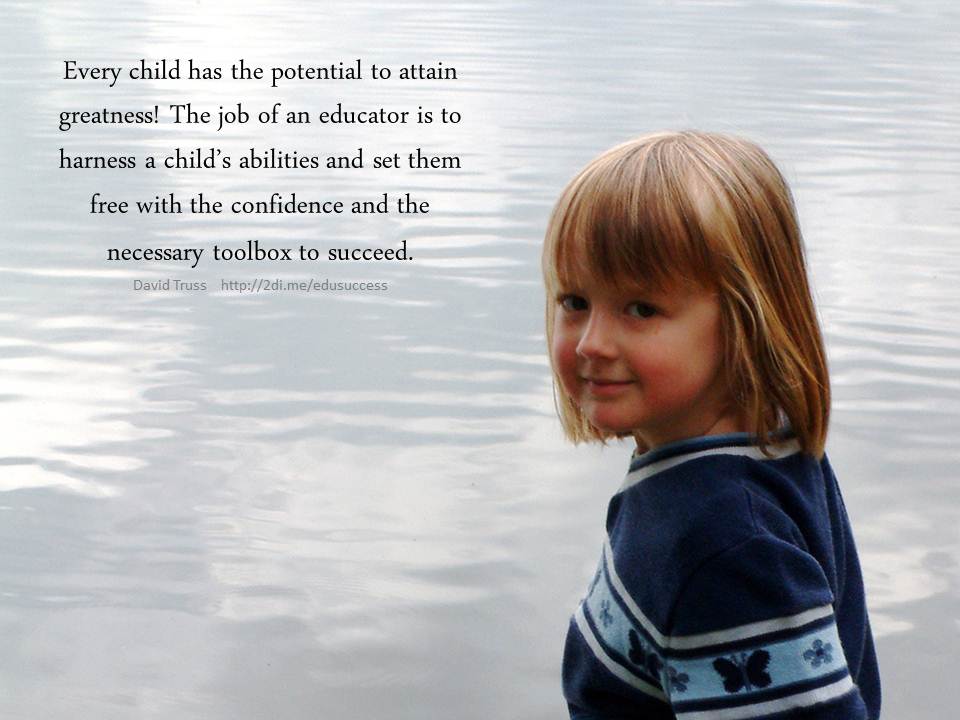
Schools with a strong leadership team, that encourage a meaningful, common vision, can help students perceive learning as a lifelong journey. In doing so, a school must encourage greatness and loathe mediocrity. Educators must maintain high expectations and strive to see students excel. Students must be given the opportunity to maximize their potential and they should be inspired to do so. Every child has the potential to attain greatness! The job of an educator is to harness a child’s abilities and set them free with the confidence and the necessary toolbox to succeed.

Originally posted: May 23rd, 2007

Reflection upon re-reading and re-posting:

In his brief comment on the original post, Harold Jarche said, “I really like your first paragraph. It captures the essence of education.”

That puts technology into perspective! Technology is a tool used to help us get to the goal in the first paragraph. “Do not confuse the pointing finger with the moon.”

A Giant Teaches Me About SUCCESS: a “what are your secrets to a successful life” meme

Thursday, April 24th, 2008

I’ve been tagged with a “what are your secrets to a successful life” meme by Kelly Christopherson. To be honest, I was dreading being tagged by a meme… I knew it was going to come eventually, but my writing process, my flow, seldom lends itself to creating lists… they are too linear for my big picture-right brained thinking process, and they often come out very contrived. However, Kelly dedicated his post to his Grandmother, and this reminded my of a special list related to this topic that I have already written.

So I dedicate this post, (my portion of my Papa’s eulogy), to my grandfather, Leon Bernstein, March 24th, 1924 – December 4th, 2000. He really is the best role model for success that I have ever had the pleasure of knowing.


Papa B. is a Giant!

Like many of you, I know this because he told me so.
Papa wasn’t boasting when he said this, he was just
telling you the way it is. If you were to measure a
man by the legacy he leaves behind Papa would come as
big as they get. In this way he is still a giant and
always will be.

Five children, 13 grandchildren, and a growing number
of great grandchildren, currently at 5 and a half,
make quite a legacy for Papa and Granny. Papa called
his great grandkids his Third Crop. Just on Sunday he
told me, “Boy, if I knew my Third Crop was going to be
this much fun, I would have had them first.”

We all miss Leon Bernstein, Mr. B., Dad, or Papa. But
our lives are so much richer from knowing him. Like
many of you here, I never really thought of living
without him in my life before now. Yet, I feel sorry
not so much for us, but for his Third Crop, for my
daughter, who will not get to know him. I speak to you
today to share with you some of the wisdom Papa has
taught me: some wisdom that needs to be passed on to
Papa’s Third Crop.

So here are some lessons or rules that Papa lived by,
rules that made him the Giant we all know.

Rule #1
“Don’t wait for it to completely break before you fix it.”
Papa would walk into your house and see a loose tile
in the kitchen. Two days later, he would show up with
his tools and mend it before it became a problem.
There is an old saying that says, “Kill a snake when
it is small”. Papa never had to deal with large
snakes.

Rule #2
“Stuff happens, just move on.”
Papa never dwelled on bad things, he would just move
on and, “Call that Wally”. I can not remember Papa
being mad for more than five minutes. He knew there
were much more important things to focus on. Like his
favorite sports team, or making sure everyone saw the
beautiful sunset from his balcony. Or just playing
with his grand and great grand children.

Rule #3
“Don’t waste time on stupidness.”
This rule could also be called, “I look stupid to
you?” or the “What de-yass is dat?” rule. Papa didn’t
have time for stupidity. On this topic, Papa was very
expressive. He always used his time and never wasted
it. On the same note, Papa was always fixing things
and if there was a smarter way to do things, or a
short-cut to use, Papa found it. It was usually just
after one of his time saving discoveries that Papa
beamed, and would say, “Man, Papa is a Giant!”

Rule #4
“Enjoy everything you have.”
For Papa, nothing was too small to be appreciated. He
made it an art to celebrate the little things in life.
From his morning coffee and jumble puzzle to a
handmade birthday card from a grandchild, Papa
appreciated all that life had to offer.

Rule #5
“Business is business and pleasure is pleasure.”
Papa had the amazing ability to put on and take off
his business cap. He never mixed the two. He had the
knack of being small town friendly and big business
savvy without ever letting one get in the way of the
other.

Rule #6
“Be small town friendly.”
I remember going to a shopping plaza early one
morning with Papa. A woman walked pass us as we got
out of the car and she said, “Good morning”. Papa
replied, “Good morning,” and then said, “You’re from
the islands.” The woman stopped and looked up oddly at
Papa wanting to know why he thought she was from the
islands? Papa replied, “Because you said good morning,
in a big city like this, people don’t talk to
strangers in parking lots”. Turns out she was from
Trinidad. Papa loved to get to know people. From a
sales clerk, to a door attendant, to a doctor, to a
President, Papa was a magnet that people could not
help but be drawn to.

Rule #7
“Never retire.”
This is what kept Papa young and fun. He didn’t
retire…He became a tiler, a carpenter, a chauffeur, a
landlord, a banker, a fund-raiser, a board member, a
baseball coach, a plumber, a jack of all trades. He
continued to learn and to grow. He did all this
without spreading himself too thin. He did all this
keeping his family a priority, after all his main job
was as a loving husband, father, grandfather, great
grandfather, and a true friend.

Rule #8
“Smile…a lot.”
With us, his second crop, and his third crop too,
Papa could often be found, laying down on the carpet
with kids playing on and around him. His smile would
light you up. He would nap on the floor in a crowded
room, wake up and pretend to be mad for 10 seconds or
so because his grandchildren put hair ties and clips
on him. We would laugh and then you would see a glint
in Papa’s eyes and a smile that was contagious. Papa
was happiest around family and that happiness was
contagious too.

Rule #9
“Take care of your family.”
If I had to rank these rules, this would be number 1
with Papa. From fixing your toilet, to helping you at
the bank Papa was always looking out for you. As I
look around this room, I think I’d be hard pressed to
find a single person that he didn’t do more for than
they did for him. When it comes to family and friends,
he is the best role model anyone could have.

Rule #10
Always remember… “Papa is a Giant!”


Papa B's Crop

Papa B’s “Crop”, July 2007. His third crop count is now 10… and will continue to grow.


Originally posted: April 14th, 2007

Reflection upon re-reading and re-posting:

It occurred to me that some of the rules such as #3 and #6 deserve a little background knowledge. My grandfather fled Poland with his Dad, Uncle and their families as a boy… they ended up in Barbados and my Papa developed a very strong ‘Bajan‘ accent. He had a great lilt to his speech and he could make a swear word sound like the melody of a song. If he said “What de-yass is dat?” it would not come off as swearing.

Also, in Barbados #3′s title, “Don’t waste time on stupidness.” would actually be said something like this: “dow-wase na-time-pun stupidness”. I always say that English is both my first and second language. When I moved to Canada absolutely nobody understood me. My sister’s accent was so strong that her teacher wanted her to go to ESL.

One final note. My Great Grandfather (ol’ Papa) and Uncle Sol tried to talk the rest of the family into joining them when they fled Poland… their response: ‘We are in the sweater business, what are we going to do in the Caribbean? The answer turned out to be ‘LIVE’! Most of the family that remained in Poland were killed in the second invasion.

- – - – -

Comments on the original post:

  1. What a Papa! How lucky to have such a treasure in your life!

    A  couple of whispers from the family:

    ‘Plant your own garden and decorate your own soul.’

    If you fall, remember to pick something up.

    Eve on Sunday, 15 April 2007, 18:21 CEST

  2. Dave,

    Awesome. I spent the Easter week at home with my mom. I visited with grandma several times, took her for coffee, spent time at her house, cleaned her walk and did some outside work while my kids were inside talking with her and visiting. I am always amazed at how they pick up so much and how grandma Chris tells her stories and they listen. I think that what you wrote is something that is greater than just success – it’s about life and being human. From what I can see Papa B was indeed a huge success! Have a great week Dave.

    Kelly Christopherson on Sunday, 15 April 2007, 20:44 CEST

- – - – -

Do you have a special Life Lesson, Rule, or Secret to Success that was passed on to you by a parent or grandparent? Share it with me…

SUCCESS(full) Presentation

Tuesday, April 15th, 2008

success: Richard St. John (From TED)

This isn’t only a presentation about what leads to success… it is also about presenting successfully.

It is about how to use Powerpoint (or another presentation tool) effectively: Simple graphics, purposeful movement/animation, a single key word, effective use of bold font, a minimalist quote, good pacing, simple humour, and a message that we could all benefit from.

Simplicity is the ultimate sophistication.

Originally posted: March 16th, 2007

Reflection upon re-reading and re-posting:

I used this as part of a presentation to Grade 11′s and 12′s, (and blogged about it later). The one key thing I am starting to understand is that ‘design’ is a skill that is necessary to teach students. I absolutely hate being ‘shot to death’ by Powerpoint bullets… but realize that if I get bullet-bombed, it is my fault for not showing students how else they can creatively use this presentation tool.

Subscribe Here!
Pair-of-Dimes-RSS-Animated

Or have posts
delivered to you...
Enter your email address:


Pairadimes Odiogo Listen Button

Also connect here:

Twitter Button LinkedIn Button

Click to Translate
Explore…
Subscribe Now!
Pair-of-Dimes-RSS

Or have posts
delivered to you...
Enter your email address:


Pairadimes Odiogo Listen Button

Also connect here:

Twitter Button LinkedIn Button

Delicious Button YouTube Button

Flickr Button FaceBook button

David Truss
David Truss Background
DavidTruss.com
My 'About' Page
Resource On
Student Leadership
Newsletter ('08)
Digital Magic
Follow me:
Follow me!
Around the Web:

Search Pairadimes
My picks
Two Wolves Which wolf will you feed? A Remembrance Day Post
- - - - - - - - - - - - - - - - -
Warning! We filter websites at school.
Filters filter learning!
- - - - - - - - - - - - - - - - -
My blog is my PhD I have given myself a Blogtorate of Philosophy.
- - - - - - - - - - - - - - - - -
Bubble Wrap What we are doing is creating a facade of security, nothing more than an illusion of bubble wrap.
- - - - - - - - - - - - - - - - -
Who are the People in Your Neighbourhood? My (digital) neighbourhood spans the globe.