It was David Warlick‘s Keynote that introduced me to this wonderful, free online conference, and although I had a blog for 6 months before that, I wrote a key post that influenced my future as a blogger.
And now a much admired friend Kim Cofino has created this wonderful 2009 Pre-Conference Keynote:
As someone living in Asia now, Kim’s metaphors in Part 1 really hit a chord with me. I especially like from about the 5:30 mark until the 14:30 mark: ‘Lessons from Culture Shock’. At the 7:45 mark of this presentation Kim states,“We have to find ways of more nimbly, realistically and effectively adapting to the new status quo.” What excites me is that the ‘status quo’ is based on connecting the students in our world in more meaningful ways… We now have the ability to foster cross-cultural connections with kids who aren’t just ‘growing up digital’ but also ‘growing up global’.
As one of Kim’s connections in Asia, I had the chance to play a small part in this presentation. I sent her the video below that she edited and added to the presentation above. The idea for this actually came from a Twitter discussion with John Davitt as he was preparing for a presentation. I sent him these-two-tweets and very shortly after Kim asked for a video clip… it was already written, I just had to film it.
Here is my ‘Connected World’ Video that I made for Kim:
It is a fabulous time to be an educator! Watch Kim’s presentation. Watch it again and think about the potential for what we can do in our classrooms today. Connectivity is key. Adaptability is key. We live in a connected world and our students are going to have to learn about each other, connect with each other and adapt to different working and living environments. Let’s adapt our schools to meet the needs of student today, instead of trying to make students fit into an old model of what schools used to look like.
I wish people would stop trying to compare old ways with new ways and started asking, “What can we do with this amazing new tool?” or “How can I use this to engage learners?” or better yet, “How can this empower students to pursue their own learning?”
And we had better start doing this soon!
Why?
PODs. We are about 5 years away from most of our students bringing PODs to school, Personally Owned Devices. I’m talking about pervasive access to laptops and iPhone-like devices in our schools. Every kid coming to school with more capability in their pockets and hands than most teachers have on their desk right now.
So now a big question comes to mind. At the pace we are going now… Will we be ready to utilize these amazing tools that will be brought into our classrooms?
I say no!
So, new questions arise: What do we need to do to be ready? What needs to change? How do we maximize what we can do now? Who makes this happen?
No it’s not about the technology… you don’t need technology to promote inquiry and a love of learning in students. It is not about preparing our students for the future… it is about preparing our teachers for the future. It is about asking ourselves the right questions and promoting a spirit of inquiry with our teachers. And finally, it is about leadership.
But traditional leadership alone won’t work. It is YOUR leadership that we need. Do not go quietly into your classroom. Do not go quietly into your schools. Do not wait for PODs to arrive. You are the one that can make a difference… ask yourself, “How can I prepare my colleagues for the future of education?”
I’ve asked a lot of questions, and I’ll provide an answer to one of them now:
“You know the No. 1 complaint about school is that it’s boring because the traditional way it’s taught relies on passive learning,” Mr. Noguera said. “It’s not interactive enough.”
How are we going to make that work in our school?”
- – -
“When someone wants to ban something, I ask myself,
how can we use this to help us in education? ‘It is a new tool’. Not obstacles but opportunities.”
Chris Kennedy
Which takes us back to the New York Times Article:
Ms. Poli said her Spanish-speaking students — known around the school as Pod People — have been able to move out of bilingual classes after just a year of using the digital devices, compared with an average of four to six years for most bilingual students.
Winnie Hu
Access
We have the capability to access like never before! Recently I have thought a lot about how things have changed, about how we digitally engage and interact in our world. There are so many opportunities available to us.
• Our lives are open, public and on display.
For under $100 you can have iLife ’08 and produce, publish, print and share what ever you want with the world. Fifteen years ago $10,000 couldn’t have given you the same opportunities… and there are free versions of similar (and some better) tools popping up all the time.
• Online networks help to define us.
My Blog, My Flickr, My Space, My Facebook, My Friends, My Profile, My Second Life, My del.icio.us, MyBlogLog, My Ning Network, My Twitter, My-Whole-Life-Connected-and-On-Display-For-Anyone-And-Everyone-To-See…
• Growing access to customizable tools and networks.
Maps of the future are being used as a catalyst for conversation. As Mark Van’t Hooft of Ubiquitous Thoughts notes, the map “…lists half a dozen external forces that will affect education in the next decade in the areas of family and community, markets, institutions, educators and learning, and tools and practices. With regards to digital tools, it is noteworthy that the focus seems to be on mobile and connected devices, in an environment that favors personalization/customization AND networking/connectedness at the same time.”
• Personalized learning that responds to a learner’s needs.
Machines are finding creative answers to problems… This site, Think Artificial, also introduced me to Virtual Tutors: Launched in March, uMind “…employs AI to create a virtual tutor that recognizes and adapts to the student’s limitations and emotional distress. The instructor knows when a student is stumped and activates extra teaching modules on the specific subject.”
• Life extended beyond the physical world.
Moving beyond just Web2.0 sharing. The first time I saw Gary Hayes‘ “THE CHANGING INTRAWEB – FROM 1.0 to 3.0” was the first time I considered the possibility of Web3.0. Today there seems to be a very real weaving of real-life and virtual realities for more than just entertainment. We will find ourselves engaging in, and fully integrating with, a digital universe — a metaverse — “This ubiquitous cloud of information is like electricity to children of the 20th century: essentially universal, expected and conspicuous only in its absence.”
Obstacles
Yes there are Obstacles … and they aren’t going away fast enough. The most basic one is once again access- (or at least lack there of). Carolyn Foote‘s post on The disconnect notes the many roadblocks teacher face, (“the disconnect between “the possible” and what’s permitted in schools”).
Here is what I said in a comment on Carolyn’s post:
I’ve been limited by the technology my school can provide time and again:-(
About a year and a half ago, I got out of Plato’s cave, saw the vibrancy technology can provide in a student’s learning experience and I have been constantly thrown back into the cave to watch the technology-less shadows… A disconnect indeed!
For me the (hardware) tools are computers, ideally wireless laptops.
For many others, as I have been learning, the (web2.0/software) tools themselves are unimportant compared to access, opportunity, and COLLABORATION TIME. Tools are getting so much more user-friendly, but using them for learning (rather than just to teach old things in new ways), that is the trick. Case in point: I have seen a few blogs where students answer a teacher question, but don’t interact with each other in any meaningfully way.
So for many teachers collaboration time, or training, or professional development opportunities are more important than tools (in my humble opinion).
Put 2 or more well-intentioned teachers in a room and practice will improve. Don’t offer specific tools, offer opportunities for people to Connect & Collaborate & Creatively engage with tools of their choice.
Oh yeah… but make sure they have the technology available to make this time useful when they get back into their classrooms!
Access Granted
On many levels, ‘access issues’ are key obstacles. Yet, opportunities abound! The web lets us collaborate in manydifferentways! So now I have to wonder: Do we want our discussions to be around what we can’t do?
It isn’t so much about ‘New Boundaries‘ as it is about removing boundaries. There were holes in the Berlin wall for years… innovative teachers today are escapees from behind similar walls. It is time to tear the old ideological walls down. Teachers and students need access granted!
Originally posted: October 9th, 2007
Comment on the original post:
I’m just discovering this post after you shared it on twitter during Educon! It is such a fresh way of looking at the issues involved. I’m going to add it to the wiki for reflection.
I think identifying this as an ideological battle is significant. It’s about the difference between fear and opportunity. I think we have to be informed, and inform our districts as well, and we each have to help on the front lines by spreading hope not fear.
One of the most amazing things about our district is how open it is… and we are building an infrastructure designed for our students to be able to bring their own hardware!
In 5 years, a teacher won’t need a 1-1 laptop program, but instead just 2 or 3 ‘computers’ for those that do not bring their own to class. Why? Because I figure in 5 years instead of carrying around an MP3 player and phone/camera, almost every student will have a jazzed up iPhone or equivalent tool. They will be bringing their own tools to class. With the hardware obstacle out of the way, we can start focusing on the use of technology to Connect & Collaborate & Creatively engage the learner… allowing our student to Construct their learning and Create meaning.
I’ve seen a real shift in my own thinking recently. Forget whining about access, disregard the slow speed of change, get over the obstacles! Go after meaningful results. Engage and empower students. Be a leader and a role model.
Next, my commitment to consistently keeping a personal blog got started a little later. An early inspiration was the K12 Online Conference 2006 keynote webcast by David Warlick. I wrote a post in response, which I did after the conference was over… welcome to the anytime, anywhere experience of an online conference. However, it is even more engaging to participate during the conference when you can interact and learn with other participants… Join the Learning Conversations!
Just click on the image below to find out more.
Originally posted: September 26th, 2007
Reflection upon re-reading and re-posting:
Here it is, short-and-sweet: My plate was too full to participate!
I was so busy building the Graduation Transitions program that all I did was listen to the keynote and I was done. Since then I have followed up a bit, with the highlight being an introduction to “Unprojects” as served up by Chris Harbeck.
I find it somewhat ironic that I added to the title of this post, “(at your leisure)” and then had no leisure time to participate.
…and now here I am: Trying to move my blog post-by-post, reflecting along the way; Learning the ropes as a new VP; Trying to be a great husband and father; Trying to get back into shape (I spent an hour on the treadmill today); and trying to prepare 3 presentations for BLC08. Leisure time will resume in August:-/
“I come from the Batman era,
adding items to my utility belt while students today are the Borg from Star Trek,
assimilating technology into their lives.”
That’s a quote I use to differentiate digital immigrants from digital natives.
BUT I have realized that it is much more about comfort level & exposure than it is about age. While I am helping some frustrated students open a sign-up verification e-mail, other students have logged into the new site, added a photo, and changed the appearance of their personal page.
There are three digital divides here preventing me from effectively using technology in the classroom. (Two from my post, and the 3rd added from this Classroom2.0 discussion.) These divides are the gaps between:
1. What I know and what I need to know.
2. What the school has in the way of technology and what it needs to have.
3. What skills/abilities students enter my class with.
#1 I can change.
#2 will never change fast enough.
#3 is the shift in this conversation.
I have both immigrants and natives in my class, so the distinction is moot.
“And then there is my class Science Alive! wiki… “I think that I am guilty of seeing the value of using technology in guiding learning, but not effectively guiding learning in my technology use.”
I have done a pretty good job of getting my students going… but now as momentum builds I have come to the realization that I don’t have a marking rubric to guide me, or my students, as we move towards a final product.
My class is assembling a lego model without the instructions, or even the image of the final product on the front of the box. This isn’t a problem for the creative/motivated students; they will assembly a better model in ways that I could never have ‘instructed’ them… but some students need structure, they have been fed it for years and expect it (even from yours truly – this isn’t finger pointing, it is observation).
I let technology supersede pedagogy.“
Digital immigrants or digital natives is nothing more than a discussion of digital competence… it is a spectrum, not a dichotomy!
Where does this leave us?
We want all of our students to be digitally competent.
We want all of our students to be articulate thinkers.
We need to make this happen in pedagogically sound ways.
- – - – - – - – - – - – - – - – - – - – - – - – - – - – - – - – - – - – - – -
“…technology adoption… It’s typically a four-step process:
1. Dabbling.
2. Doing old things in old ways.
3. Doing old things in new ways.
4. Doing new things in new ways.”
I think we get excited when we see ‘new things in new ways’, but often we end up (re)creating old things in new ways. The real conversation needs to be around the constraints of curriculum and standardized testing.
“This is why the foundation of education systems today should not be the rails, but it should be the side trips. It should not be the central standard curriculum, but it should be those directions that students, that learners, both teachers and students, can navigate to on their own.” (David Warlick)
New things in new ways… creating articulate thinkers… and building digital competence as a by-product.
Originally posted: September 19th, 2007
Reflection upon re-reading and re-posting:
I remember laboring over the semantics of my title for this post. I used the word ‘spectrum’ then changed it to ‘continuum’ and then back to ‘spectrum’. The reason I stuck with ‘spectrum’ is because the competence and exposure to technology that students face today are not uniform as a continuum may suggest. Students can have very narrow bands, or very wide arrays, of knowledge or expertise when it comes to their use of technology. So if I were to make the post title into a statement it would be:
Rather than a Digital Native/Digital Immigrant dichotomy,
students have a wide spectrum of digital competence
positively correlating to their digital exposure.
- – -
I’ll save the conversations around assessment, pedagogy and standardized testing for another day.
Comments on the original post:
David,You always do such a great job of bringing things together, focusing on what is truly important and not the chaff. Schools and school jurisdictions are slow moving in so many ways. They are not adept at recognizing change or at responding to that change. This, at times, has been a very useful such as when bandwagon ideas and such were not able to make big headway. However, we have come to a time when change is necessary and vital to our ability to prepare students to transition to that place we call world. Unfortunately we cannot continue to wait until everyone has reached stage 3 or 4 as outlined by Prensky because, as you point out, our students aren’t even there. With the shifting sands of technology, I don’t believe we will ever get there. Educators will need to become comfortable with being uncomfortable, with change being a constant and not having all the answers. When we realize that we, too, can be borglike if we but allow ourselves the opportunity to revel in the change and not fear it, helping our students will become synonymous with helping ourselves. Keep writing, David. You have a gift for sifting and finding that nugget. Btw, I’d like to try the book club idea again. Interested?
Thanks for your kind words Kelly!“Educators will need to become comfortable with being uncomfortable, with change being a constant and not having all the answers.” What a great point. We expect our students to change, grow, and be lifelong learners… should we not do the same!Yes, I would like to try the book club again, and yes we can make it work this time… but I need a couple more weeks before I can think of opening a book for pleasure. Do you have any in mind?
David Truss on Thursday, 20 September 2007, 08:32 CEST
The Borg! Resistance is futile – therefore we all will be assimilated into the Web2.0…I am neither immigrant nor native – I am an illegal alien and loving it!
David,You certainly have a great take and grasp on the issues education faces, especially in regards to technology in and out of the classroom. I’ve enjoyed so much, your “thoughts”.Isn’t that what it is all about? Whether it be a violin, a pen or a mouse – this interaction with ourself, the fertilizing of ourself to bring more splendour and light into the world?We are doing that here, you are doing it so well with your blog. It is your violin. I enjoyed the stories so much and you’ve inspired me and I think I’ll start a story of the day on my own site – stories for teachers.I’m gonna keep lurkin’
I’ve been having this conversation in a few different places, and now I need to put my thoughts together. Here is a summary of some discussions and e-mail messages, a Wesley Fryer’s post “Advice for designing the school of the future” and my comment there, and my forum post in the School 2.0 social network on Ning.
It all started here:
My daughter’s school is going through seismic upgrading. 2 years of noise and upheaval… 1/2 the school sealed off, with the kids in portables, then a year later the other half goes to the portables and the kids in the potables move to the newly revamped wing. They are practically taking the roof off, half a building at a time.
After a PAC meeting I asked the principal what technological improvements were going to be made to the school…
NONE!
Not going wireless (apparently too expensive!?!?)
Not even extra electrical outlets in the rooms!
Certainly not a consideration to redesign a library built to store walls of encyclopedias. (I’ll discuss this point later)
The problem is the financial handcuffs placed on the principal to meaningfully do anything to improve the school at this time. Why? Because money set aside for seismic upgrades is from very different coffers than those of renovations/improvements. What does this mean? It means that we won’t spend $10,000 now to wire the school with extra plugs and create a wireless network… but we will necessarily have to do so, for $25,000 in two years, (when the walls and roof have been seismically upgraded).’ [These costs are an approximate assumption of mine, and not based on any specific research done on my part.]
This well said response was given to me by Brian, our district’s Manager of Information Services. He responded to my e-mail and also wrote a response to my comment on Wesley Fryer’s post:
“I agree wholeheartedly with Wesley’s school 2.0 description and David’s concerns. The culture in bricks and mortor schools and districts takes a long time to shift… The challenge not specifically highlighted in David’s comments though is the how government and / or local district funding rules work. For a seismic project, we are very limited in what else we can “add on” to the overall scope of work. And, there are no other pots off money to draw from to “do the right thing” with the renovation. It’s unfortunate but our reality…That said, our vision for schools would encompass the school 2.0 idea. With time, the vision can be realized.”
Brian has been working on a district learning portal, and so he knows the value of having connected classrooms. But the ‘right thing’ can not be done at this time.
I had an interesting conversation with a former student’s parent a few days ago. She works in construction for a number of different school boards, and has done so for over 15 years. Although she isn’t working specifically on my daughter’s school, she told me how easy it would be to first, make the school wireless (a job that literally would take minutes during the construction), and then also to run the wire to add electrical outlets to the classrooms, while the seismic upgrading is taking place. She agreed with me that financially, this task would be significantly cheaper during construction. And in her words, the reason this won’t happen is because in the case of every district she has worked for:
“They Do. They Think. They Re-Do!”
At first, I took her words in jest, but as the conversation continued, and she went back to that phrase (without exaggeration) over a dozen times. I then realized that she truly was talking from experience. I could see her frustration, she shared my exasperation, but could offer no solutions. Just as has been mentioned above, she reiterated that there is simply no additional money to do these kind of improvements. She stressed that this was especially the case with seismic upgrades because these upgrades have, in the past, been grossly over budget due to ‘add-ons’ that clever principals and district superintendents have added to the upgrades in the past. This has resulted in very strict limits placed on what can be done while this construction is happening.
‘We can’t afford it now, so we will pay significantly more to do the same thing later!’ I find this so asinine.
Another aspect to this has been the design of the school library. My daughter’s school has a computer lab next door to the library, but there is no door between the two rooms. I wonder how hard it would be to place a sliding door, or remove the wall altogether?
In his post “Advice for designing the school of the future” Wesley Fryer suggests:
“I think the school of the future should be centered around the library, and include not only great places to read but also inviting places to collaborate and work together, sort of like a Starbucks atmosphere. I think the library should have a design and performance studio, which would permit students to craft high quality media products for the global stage: the web. I think an educational learning portal should serve as a primary learning centerpiece. One of the big things we need to do as school 2.0 educators is redefine our identities as teachers: It’s ridiculous for us to attempt to be experts on all the content subjects we teach. We really need to embrace the model of facilitating project-based learning, so the physical structures of school should support that pedagogical framework.”
Here is part of my comment/response to his post:
I agree with you, “One of the big things we need to do as school 2.0 educators is redefine our identities as teachers” however, as you say, “the physical structures of school should support that pedagogical framework.”
As someone who is struggling with the availability of technological resources, I can say that the framework really should come first!
A question to you Wesley, what can we do as teachers, as members of society who have seen the outside of Plato’s education cave.. who know that there is more to life than shadows on our school hall walls… what can we do to tear down those walls and build schools that are designed for school2.0 rather than school1890?
I think that the reality is that many brand new schools being built today are not fully embracing the possibilities of the future. Partly because we don’t really know what that future looks like, and partly because of financial constraints.
I posed the following question in the Ning School 2.0 forum:
In my daughter’s school, I will fight for wireless, and I will suggest more power outlets in the classes, (so that eventually if they get, perhaps, a row of computers on a wall, or even a mobile computer lab, at least students can power their computers… but what else would you ask for?
And after a few days I’ve only had one response, (which I will get to in a moment). What I find interesting is that nlowell has an interesting forum post asking, “What is the purpose of the classroom?” Go no further than the very first response to see Heather Burlesson’s poignant statement:
“I don’t think we can continue the industrial model. Today’s students do NOT want to be robots, and they have the tools at hand to reject all our attempts to force them into such a mold.
How can we actively engage them while satisfying the system? I’m not sure what the answer is, but I’m fairly certain any change will have to start within the classroom itself. Transforming the “brick and mortar” into a place the kids *want* to go to – My*pace for the flesh and blood part of the day – that’s the challenge we are facing at the moment.”
In essence, we may not like the current ‘industrial model’, but we really don’t know where education is going. This makes concrete suggestions difficult… there really is no blue print (no road map as they say) to the classroom of (as little as) 25 years from now.
I really loved David Warlick’s response to this kind of question on his blog – his proposal? The one non-budget-blowing thing he would do first is put all school furniture on wheels! Think about this –one of the key elements of project based learning and indeed, practicing 21st century skills is student collaboration. Let’s move those desks around – set up collaborative work space, and a place for presentations.
I agree that the school library is the learning and information center of the school – especially in the age of technology. If creating collaborative work spaces in classrooms seems difficult to navigate, then start with the library! This is where you’ll find staff who truely understand the concept of School 2.0 – and how to collaborate with teachers to create incredible learning experiences for students using 21st century tools and resources.
I think that Warlick’s idea of the classes no longer needing to be ‘anchored’ is indeed a good starting point. It invites the opportunity for change, and it prepares us to be prepared to try things in new ways, while also encouraging opportunities for collaboration.
So now that battle must rage on. I will be meeting with my daughter’s school principal next week, and it is my goal to create a ‘wish list’. It may be a moot point, but to me we cannot complain about the situation and then ‘sit idly by’ and allow nothing to happen.
I welcome other suggestions, other wishes, that you would want to see during a ‘renovation’ such as this…
I had the meeting with my daughter’s school principal and I was very impressed with what she was advocating for. I also liked that the Library design was being thoughtfully considered. On a current related note, check out Alan November’s podcast interview with 16 year-old Zaki Tahari who created a virtual mock-up of the newly planned library at his school, with his own unique design elements added!
On the topic of changing schools, I think I have reached some resolve around the idea that schools will never be caught up, or up to date, with the technological needs they require. That said, and accepted, I think that we have great potential to do some really creative and innovative things with the money we do have to spend.
The challenge we have now is deciding what we can do now that creates opportunities rather than obstacles later on.
My most recent post, “I’m a mop not a sponge” , highlighted a metaphorical epiphany that one of my students had about his learning style. This post will look at metaphors I have found on my journeys through the blogosphere since then.
2 rules to my quest:
1. The post title must contain a metaphor.
2. The meaning behind the metaphor has to be worthy of quoting/highlighting/linking to.
I’ll start with Lynn losing her glasses. Her Optical Powercut gave her a new perspective on things:
So, what have I learnt? That it’s good to look at things differently sometimes and everyone is much thinner than I thought!!
I think sometimes even ‘rose coloured glasses’ can impair our view of contrasting colours… and ideas!
Moving outward from personal ‘insight’, Carolyn examines classrooms with glass walls , she wonders about the safety of ‘open’ classrooms, but candidly admits,
One of the debates I’ve been having recently has to do with the publicness of learning through 2.0 tools like blogs. Don’t get me wrong. As someone who’s been blogging for almost nine years, and has a dozen different status messages broadcasting my moods & motions 24/7, I’ve set the bar low when it comes to my own privacy.
So we make ourselves ‘open books’ but justifiably worry about how ‘open’ our classrooms have become.
Our natural curiosity is like a wild animal; it hunts where it needs to in order to satisfy its deep hunger. As children, we awaken each day with an insatiable appetite to learn. It is in our early years that we are “wolves of learning”. There is a deep, DNA-based, natural connection between learning and survival; call it the burning relevance of the empty stomach.
Pete states that institutionalized learning has tamed, “The wildness of our natural curiosity…” and concludes very powerfully,
Let us find ways to give our children back their birthright, their natural curiosity and facility to learn. There have to be ways that we can organize our learning institutions to accommodate individual curiosity and the standardized curriculum. I believe that thoughtful educators can create environments that are less restrictive and provide much more natural habitat for learning. Let us find ways to foster the wildness and thrill of learning again. Let us answer the “Call of the Wild”.
This reminds me so much of the many links I provide in my metaphorically titled Square Peg, Round Hole post, which -each in their own way- comment rather eloquently on the misgivings of our schools… (Note Warlick’s Alien World and the very appropriate Animal School for other meaningful metaphors on this topic.)
And finally on a larger scale Miss Profe notes, in What Really Makes the World Flat, where the most meaningful ‘bridges’ can be made,
Global bridges are important and necessary. But, what about the bridges that can be built between, say, a suburban school and an urban school within the same community? What about making connections between people who can have a real impact on each other and who may be dealing with similar issues? We can visit and meet face-to-face, and see how mutual suggestions are benefiting each other. One does not need a blog or a wiki to do that.
This reminds me of one of my favorite metaphors I use with students, John Heider’s interpretation of Lao Tzu’s Ripple Effect found in The Tao of Leadership. Our ripples of influence may be far-reaching, but often our greatest influence can be closest to us, where our ripple can be felt most. Miss Profe concludes,
Developing a deeper understanding of one’s community and the people who live there can provide a transformative learning opportunity for students, and in the process, lead to a flatter world in the most profound sense. As we like to say, learning is messy, and there is nothing messier than connecting with The Other within one’s own backyard.
Although I agree with Miss Profe, and value her focus on impacting our own personal communities, I also think that our digital world has made it much easier to have an incredible impact on a global scale.
It is Miss Profe’s words that are resonating with me now. I have very often felt ‘all alone’ as I embarked on my web2.0 adventure. I have ended up connecting via my blog, and skype, and twitter to teachers in other Provinces, States, and Countries… yet know very little about the things going on in my own district. My outward focus of attention has not been intentional, but rather just ‘easy’.
This is similar to what I have been dealing with as I get used to our new Sharepoint portal. The fact is that the move towards such a portal has been really healthy in promoting the use of online tools into the teaching practice of our district. Alan November has said that ‘we’ are years ahead of other districts. I know this would not have been the case if it were not for the portal. Yet for someone who has been playing with web2.0 tools for a while, the (current) portal tools feel so restrictive and counter-intuitive. We are in the process of upgrading which will change that significantly, but I couldn’t sit around and wait for that to happen.
So for me, it has been easier to ‘go outside’ of the district. However, as more and more teachers ‘get connected’, and as the portal tools become more user friendly, I need to start looking in my own back yard for some meaningful connections.
- – -
Comment from my original post:
My thanks for a thought-provoking post and for sharing my image with your readers. I am analogy-driven, close cousin to metaphor, and I found the points you made compelling. My ‘Spring Carnival’ yarn which you closed your post with is, ironically, not woven but spun. Maybe the world is not just not-flat but is spinning; which begs the question: spinning out of control or just going round-and-round, like a top on it’s axis, like the moon around the earth, like it is supposed to. Cheers!
Velma, COLORBOMB Creations on Monday, 09 April 2007, 00:32 CEST
Until now I have been adding my reflection at the end of these re-posts. However, I thought with this post it should come first. Why? Because it is important that I share the date of the original post before quoting other bloggers who were expressing views/moods they may not currently hold.
Of all my posts, this one really seems forward thinking and, well, prophetic. We truly are ‘heading map-less into new, and uncharted territory’. And we really can ‘be the change we want to see in the world’. This can be an exciting time to be an educator… we must remember that even when things are challenging!
- – -
It has been eerie. Unsettling.
I’ve been restless. Dissatisfied.
… and I don’t think that I am alone.
“Shock and awe” may not be the best formula for conversations and learning. Maybe I need to craft and share a more basic, simple message, and avoid overwhelming people with too many scary statistics and ideas.”
“There’s nothing new here, really. I know. What’s new for me at least is that if feels like my lens for all of this is changing. And that’s why I’m stuck as to what to write about here. My learning and classroom learning look very different. I will never enter another physical classroom as a “student” again, and that’s by choice. That physical space just doesn’t cut it. And schools are all about physical space. And control. And content.”
“Really, we, as educators, live in a world of dichotomy – where one part of our world is moving so quickly it takes our breath away while the other side hardly seems to move at all. There we are, stuck in the middle trying to somehow bring these two together. Some people are doing a fantastic job while others are so overwhelmed that they stick with what they know, which, we are finding, doesn’t fit with our present students which is causing some serious problems.”
“Let’s Rethink It Order and discipline in a time of tremendous social change in the 19th Century. Well, It is the 21st Century and once again it is time for social reformers to rethink the reasons and ways we are educating our young.”
Tangled in the web I find Stephanie Sandifer, who thinks ActionPlans are Overdue. She points me back to Sheryl and Will (whom I had already read), as well as Miguel Guhlin, who in turn writes about Sheryl’s post.
Miguel’s post (overall) is more upbeat… yet this paragraph sticks with me,
“At the risk of sounding cynical, here’s a quick response on Saturday morning: Schools fail miserably about instilling democracy in our children…voting, democracy education are distractions from the REAL curriculum schools teach from and about. Democratic values are also antithetical to our schools since they are restrictive, controlled environments…they are top-down controlled, in the “strict father frame” that George Lakoff describes that tolerates no back-talk, no discussion, no questioning. Socrates would not only be drinking Hemlock, he’d be…well, you can only execute someone once.”
Miguel’s optimism comes later when he says, “…let their voices, that of the learners, ring throughout our schools, voices that speak of relevance, authenticity, and human connections…in ways that cannot be denied.”
This sounds like my friend Dave Sands who says ‘it is students who will change education’. But it isn’t coming fast enough, there are too many ‘walls’ denying our students, too many flame snuffers.
This isn’t new. I’ve been here before.
From my first post:
“In a hundred years or so, everyone now alive in the whole earth will be dead – is this not so?”… “It would therefore be possible for the human race to run its affairs quite differently, in a wise and benevolent fashion, in a relatively short time.”
…”And so?”
“The purpose of education,” said Wizard Prang, “is to make sure this doesn’t happen.” …”The purpose of a system is what it does.”
To my first collection of other posts, where I found so many people writing and talking about how schools don’t fit kids: Square Peg, Round Hole… Time and again I am finding myself in these lulls of impatience, frustration and dissatisfaction.
- – - – -
But it is all making sense to me now.
Well, that might be overstating things… but I have found some clarity.
What spurred this comparison on? My thinking can jump around quite a bit, it went something like this: We are reaching a group consciousness around ‘where we are’ compared to ‘where we should be’ with the use of technology and schools… ‘reaching a group consciousness’ reminds me of the 100th Monkey Effect… actually, this is like a web version of the Age of Aquarius… which reminds me… what were the ’9 Ideas’ or ‘Agreements’ I read about in The Celestine Prophecy about 10-12 years ago?… No wait, they weren’t Ideas or Agreements, they were… (Google search the book)… ‘Insights’! …(reading) …Wow, I can really see some parallels here!
So, here is my comparison. I will box in the text about the Celestine Prophecy Insights from Wikipedia (http://en.wikipedia.org/wiki/The_Celestine_Prophecy, Monday Dec. 12, 2007 – I’m just realizing that a date is essential when quoting a changeable text). I will then put my slant on how ‘”WE” are progressing through the insights in relation to the ‘WEb’
The Web2.0 Prophecy
THE FIRST INSIGHT . . . A CRITICAL MASS A new spiritual awakening is occurring in human culture, an awakening brought about by a critical mass of individuals who experience their lives as a spiritual unfolding, a journey in which we are led forward by mysterious coincidences.
THE SECOND INSIGHT . . . THE LONGER NOW This awakening represents the creation of a new, more complete world view, which replaces a five-hundred-year-old preoccupation with secular survival and comfort. While this technological preoccupation was an important step, our awakening to life’s coincidences is opening us up to the real purpose of human life on this planet, and the real nature of our universe.
and Karl Fisch added his multimedia presentations.
(2020 Vision – A thought provoking look at the future – 15:45)
- – -
THE THIRD INSIGHT . . . A MATTER OF ENERGY We now experience that we live not in a material universe, but in a universe of dynamic energy. Everything extant is a field of sacred energy that we can sense and intuit. Moreover, we humans can project our energy by focusing our attention in the desired direction…where attention goes, energy flows…influencing other energy systems and increasing the pace of coincidences in our lives.
Professor Michael Wesch shows US that WE are the power of the web.
- – -
THE FOURTH INSIGHT . . . THE STRUGGLE FOR POWER Too often humans cut themselves off from the greater source of this energy and so feel weak and insecure. To gain energy we tend to manipulate or force others to give us attention and thus energy. When we successfully dominate others in this way, we feel more powerful, but they are left weakened and often fight back. Competition for scarce, human energy is the cause of all conflict between people.
THE FIFTH INSIGHT . . . THE MESSAGE OF THE MYSTICS Insecurity and violence ends when we experience an inner connection with divine energy within, a connection described by mystics of all traditions. A sense of lightness–buoyancy–along with the constant sensation of love are measures of this connection. If these measures are present, the connection is real. If not, it is only pretended.
THE SIXTH INSIGHT . . . CLEARING THE PAST The more we stay connected, the more we are acutely aware of those times when we lose connection, usually when we are under stress. In these times, we can see our own particular way of stealing energy from others. Once our manipulations are brought to personal awareness, our connection becomes more constant and we can discover our own growth path in life, and our spiritual mission–the personal way we can contribute to the world.
We are Connected
Personal (public) blogs (with others commenting) rather than personal (private) diaries.
MySpace, FaceBook, LinkedIn, Explode.us, Flickr, YouTube, and personal
THE SEVENTH INSIGHT . . . ENGAGING THE FLOW Knowing our personal mission further enhances the flow of mysterious coincidences as we are guided toward our destinies. First we have a question; then dreams, daydreams, and intuitions lead us towards the answers, which usually are synchronistically provided by the wisdom of another human being.
All the quotes at the start of this post belong here… they are symptomatic of how (not why) we are not collectively moving forward. This isn’t about blame or excuses, rather it is about recognizing that things are not necessarily FLOWing as well as they could.
- – -
THE EIGHTH INSIGHT . . . THE INTERPERSONAL ETHIC We can increase the frequency of guiding coincidences by uplifting every person that comes into our lives. Care must be taken not to lose our inner connection in romantic relationships. Uplifting others is especially effective in groups where each member can feel energy of all the others. With children it is extremely important for their early security and growth. By seeing the beauty in every face, we lift others into their wisest self, and increase the chances of hearing a synchronistic message.
THIS IS WHERE WE NEED TO BE NOW!
We need our ‘guiding coincidences’ to be ones that are nurturing and powerful.
We need to collaborate, empower one another, and see potential rather than roadblocks. This is important for our children/our students, but it is equally important for us. Our ‘synchronistic message’ can’t be “impatience, frustration and dissatisfaction” as I mentioned earlier.
Our message must be uplifting. But an uplifting message isn’t enough!
We need financial support, visionary leaders, moral compasses, inspiring role models, enriching professional development, and meaningful collaboration. We also need minimally restricted content and unlimited access… these are all building blocks that ‘increase the frequency of guiding coincidences’… these are the things that inspire us, fuel us, connect us, and allow us to see the potential in ourselves and each other. We truly can ‘Be the change we want to see in the world.’
- – -
THE NINTH INSIGHT . . . THE EMERGING CULTURE As we all evolve toward the best completion of our spiritual missions, the technological means of survival will be fully automated as humans focus instead on synchronistic growth. Such growth will move humans into higher energy states, ultimately transforming our bodies into spiritual form and uniting this dimension of existence with the after-life dimension, ending the cycle of birth and death.
Web3.0 or Web3D
Gary Hayes has some ideas about where are we going next.
This is both a scary and an exciting time… but mostly it’s exciting
Reading what I have said regarding the Seventh and Eighth Insights, I am keenly aware that some of us are not ‘stuck’, and that some of us are experiencing those ‘guiding coincidences’ where everything is coming together. However, I think currently this is the exception rather than the norm
My question to you is this: When we are stuck, when things aren’t coming together, when our universe is not unfolding as it should, how do we make things FLOW?
I ask this since we are heading map-less into new, and uncharted territory.
Here is an idea that has been brewing in my mind for a while:
FieldFindr
A space where teachers can meet global citizens who have skills that they are willing to contribute to a class.
Teachers can find people in a field of interest that they are working on in their class. Volunteers can tell teachers their field of interest and also tell teachers how they would like to help a class.
The site could be sort of a combination of Warlick’s HitchHikr and MySpace or Facebook. (In a way it is more of a matchmaker site.)
You can sign up and log in as a teacher, or as a willing contributer (Volunteer) in you field of interest.
Basically Volunteers create a profile listing talents and skills. Then they set up a time-line of when they would be interested in helping with, or presenting to, a class. Then teachers can contact volunteers who have profiles of interest.
There could be an opportunity for volunteers to contact teachers too, but I think this should be done through a contact page like this, rather than by direct e-mail.
Here is a mock-up wiki that I built to give you an idea of what I mean. (Yes, I know the profile pictures are a bit big, but they were easy to format that way.)
Below the mock-up profiles, I created a space where interested contributors to a classroom could actually post their information. Teachers can find prospective volunteers by searching a particular field/subject.
However, I believe that there is a need for a fully committed portal site that is dedicated to: CONNECTING TEACHERS TO GLOBAL CITIZENS THAT ARE WILLING TO SHARE THEIR TALENTS WITH A CLASS.
At a dedicated portal:
Tag searches could easily be set-up. (See my ‘Super Tags’ post [coming soon])
Teachers could find other teachers to help them.
Positive relationships between business and education can be formed.
Success stories could inspire teachers hesitant to explore web2.0
Retired teachers or field experts can be tapped into.
There is so much opportunity for collaboration! (I came up with this list in about 3-4 minutes… and I’m sure you could add to it:-)
Once the site is set up, the opportunities and possibilities are endless!
Again, just off the top of my head, here are some kinds of volunteers we can easily tap into…Especially if we had a portal to help us do so.
• A musician or poet who is willing to judge a performance or contest.
• A Researcher willing to share new ideas in their field.
• A Math tutor who offers after school assistance on a forum. (Time differences could actually be an advantage here.)
• A dance instructor could teach ballroom dancing at a local high school.
• A retired teacher giving a video tour of a Boreal Forest or a desert he lives close to.
• An art gallery tour from half-way around the world…
- – - – -
A similar idea originally came to me a few years ago after seeing this award winning Timebank Commercial.
It came to me again a few months ago when I read this David Warlick Post where David is talking about Will Richardson‘s session at MASSCUE:
“Will did make a passionate point about how we need be talking about sharing our students’ work with real audiences. It’s engaging them in real conversations with the world they’re learning about.“
I finally had to get this idea out after reading these Wesley Fryer and Vicki A Davis posts over the weekend.
Feedback?
Originally posted: February 21st, 2007
Reflection upon re-reading and re-posting:
So, in reflecting on my blog posts I move from an unsuccessful book club to an unsuccessful portal… they would be disappointing if they weren’t so enlightening! To this day, failures are looked upon as negative as opposed to opportunities for learning. It seems conditioned into us at such a young age… this is a comment on our society as much as it is a comment on schools.
This is still a great idea… but it was DOOMED TO FAIL! Why?
1. Because it is geared to educators, not to those who would be willing to contribute. My audience and the target audience are not the same. Also the structures to build a sortable ‘bank’ of volunteers are not available for those interested in signing up, (see #3).
2. Formal measures around safety need to be hammered out. Note Kelly’s Comment on the original post:
Dave, I like this idea. I think that it has great potential. Now, the administrator comes out in me but how do we ensure that: a. The person is an expert in what they say they are b. They are safe c. There is not “inappropriate” contact between people and the students.
I think this is wonderful and we have this type of thing going on in our school with some of our local people. The big difference is that we are in a small community, people who are vounteering must do a criminal records check and any outside school projects are to be okayed by the parents. Precautions. I think that this would be an incredible way to get people from different sectors involved in the education system. This would also allow teachers to have references for their projects or assignments – would give validity to what we do in schools. That would increase the “price of stock” for educators in all areas.
3. Both Wikispaces and Ning are the wrong venues, I simply don’t have the required tech savvy-ness or financial resources (or for that matter time) to create what is needed.
- – -
That said, I can see a University really taking this on as a project. They can start with one department, say Music or Science, and promote the interests of their instructors/Masters Students/PhD students with teachers that may be interested in their skills as either mentors or experts or judges or…
There is significant need and opportunity for such a portal and I challenge anyone with the knowledge and resources to make it happen!
It was refreshing to hear Maureen Dockendorf, our staff development co-ordinator, (Director of Instruction), speak at our Building Leadership Capacity (BLC*) series introduction.
She encouraged us to become ‘intellectual companions’ that enter into ‘learning conversations’. The part I liked most about her talk was the direction of the conversation. She spoke of:
Not the Knowing, but the Process of Inquiry.
Not covering the curriculum, but ‘uncovering’ the curriculum.
A focus in innovation and creativity… how do we model this… every day?
Maureen also spoke of the 5 needs that we (students/teachers/learners) have:
The need to feel confident,
The need to feel like we belong,
The need to be potent- feel you have made a difference,
The need to feel useful, and
The need to have a sense of optimism.
(She identified her source for this, but I didn’t write it down.) ["The reference to the needs of the 21st learner were from the former president of ASCD , Martha Bruckner." -Thanks for passing on this information in your comment Maureen.]
I think that when using technology in the classroom, it would be prudent to keep these needs in mind!
- – - – -
Learning Conversations Part II
I started by saying Maureen’s presentation was refreshing. I think I felt that way because when I look back at my blog, I can see parallels to what she spoke about. I think that it is significant that the Director of Instruction in our district is prioritizing these ideas when talking to teachers interested in leadership… especially as more and more pressure is being placed on districts to perform well on standardized tests. So here is my take on what Maureen said relative to what I have written about, (here in this blog so far). Also note my Meta-Analysis of these two parts below.
Not the Knowing, but the Process of Inquiry:
Articulate your Thinking
The BIG IDEA:
One overall school goal of”Articulate Thinking”.
Building the skills necessary to develop articulate students who can express their thoughts in meaningful, articulate ways.
The Philosophical Bent:
I don’t really care if my daughters, upon graduation, can identify the subordinate clause in a sentence or if they can tell me how to find the volume of a cone… I do care that they can express themselves in thoughtful, meaningful ways and demonstrate social responsibility in their decision making.
Sharing and Engaging: Web 2-point-0h-Yeah!
Vanja both wanted, and demanded a learning conversation. For me it was wonderful to see a student expecting more from her peers, or should I say, from her community of learners.
Reflections:
From Cynthia, “I learned more by sharing than by searching.”
From Mona, “You actually get to learn with each other and help others learn.”
From Lily, “It was fun doing this project and I enjoyed this kind of learning experience when you get to find your own knowledge rather than laying it all out for you. I feel that I have achieved something really good each time I’ve found some interesting facts on the blog and the dialogues, which made me put more time into these things. I realized that this could be another way of learning new things and also communicating with each other rather than finding information by yourself.
“How do you know when your students are learning?… When they are asking the right questions.
“the use of blogs to learn not just to teach”
I need to ask myself:
‘Am I adding technology to my teaching or providing students with new learning and new ways to learn?’
‘Am I creating an environment where students will express, synthesize, and reflect on their (and each other’s) learning, or am I creating a new way to report out?’ (A glorified poster board).
‘Am I encouraging students to be lifelong learners?’
A side note: The curriculum does not come up in my line of questioning… it seems almost insignificant in this meta conversation. Does it matter what the content is, or isn’t the process far more important?
I think that if we want students to be lifelong learners, and we want them to take ownership of their own learning to any extent, then subject discipline must be, at the very least, ‘loosened’ up. [Which leads us to...]
Not covering the curriculum, but ‘uncovering’ the curriculum:
David Warlick’s K12 Online Conference Keynote (Derailing Education) “This is why the foundation of education systems today should not be the rails, but it should be the side trips. It should not be the central standard curriculum, but it should be those directions that students, that learners, both teachers and students, can navigate to on their own.” (David Warlick)
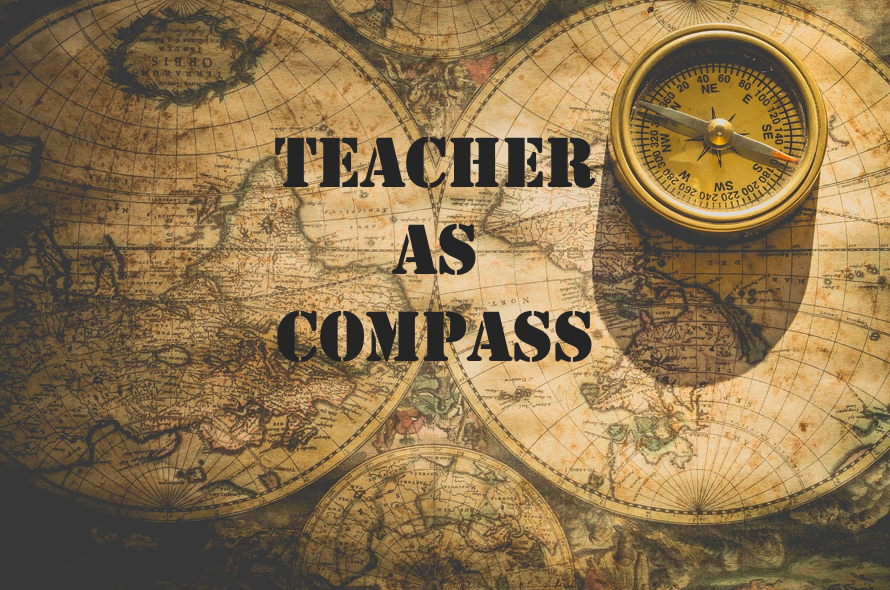
…the teacher as the compass. We point in a direction, (not necessarily the direction that the student is going), and we are a reference point or guide to the learning. As students sail (rather than ride the rails) they must choose their destination, (what they want to learn), and tack and adjust their path as they go… using the teacher as a compass that keeps them on their ‘learning’ course.
Christopher D. Sessums :: Competing Paradigms and Educational Reform
(Linked above to his post, not my short exerpt)
“The crucial elements that will sustain school improvement is not high-stakes testing, standards, or reactionary accountability programs – “it is simple human trust… that rests on four supports: respect, competency, integrity, and personal regard for others” (George 2006). “ In terms of education, the alternate paradigm acknowledges the following broad perspective:
Curriculum is best derived from the needs and interests of the learners.
Developmental appropriateness should supersede national assessment.
“The developmental needs for learners are widespread and cannot be easily or meaningfully reduced to a pencil-based exam.”
Articulate your Thinking (again, but this time from Gary Kern)
I would differentiate all learning, but I would try to cluster learning objectives so that teachers can continue to play a crucial role in learning and still be the main facilitator for learning. The computer, in its ideal form, is the tool that allows us to individualize student work. It will allow us to communicate in real time, learn in real time, and assess in real time. It will be the lever to better learning. Teachers, however, will need to be better than ever before. They will be the fuel for the flame.
…Teams of teachers would still work together to deliver the curriculum, but the interaction and model would be much different than today. Some genius will lay out the curriculum into standards and objectives that are clear and easy to follow. Teachers will bring the objectives to life, and technology will allow students to demonstrate their learning in ways unimaginable only a few short years ago. Problem based learning and rich task learning will be for the masses.
A focus in innovation and creativity… how do we model this… every day?
Many of the Square/Round Peg Students (that don’t fit into our other-shaped schools) are the future thinkers/dreamers/innovators that are going to meaningfully change our world. We need to recognize their future value… We have an obligation to nurture them, and to develop their enthusiasm for learning. It isn’t just about not stifling creativity or not making schools so alien… it is about creating an environment where every child can thrive… Not making the misfits fit, but rather helping them create a space that fits them. Application of Constructivist Principles to the Practice of Instructional Technology
Think in terms of designing learning environments rather than selecting instructional strategies. Metaphors are important. Does the designer “select” a strategy or “design” a learning experience? Grabinger, Dunlap, and Heath (1993) provide design guidelines for what they call realistic environments for active learning (REAL); these guidelines reflect a constructivist orientation:
Extend students’ responsibility for their own learning.
Make learning meaningful.
Promote active knowledge construction.
Think of instruction as providing tools that teachers and students can use for learning; make these tools user-friendly. This frame of mind is virtually the opposite of “teacher-proofing” instructional materials to assure uniform adherence to designers’ use expectations. Instead, teachers and students are encouraged to make creative and intelligent use of instructional tools and resources. (Bonnie Skaalid)
“High expectations are important and needed, but not within a rigorous environment that does not encourage differentiation and flexibility within classrooms. Learning is inherently a dynamical process, not isolated events that can be entirely centrally planned, and our educational language as well as policies should recognize this. We need to embrace differentiation, flexibility and high expectations for all students.” (Wesley Fryer)
But there is a dichotomy here: Our ‘educational language’ around standardization and accountability juxtaposed with differentiation and flexibility… we seem to have two mutually exclusive camps, yet there seems to be a move to embrace both. To embrace both is to accomplish neither.
We need to be adept at creating flexible, differentiated learning environments.
We need to be computer literate, and also be able to teach a new kind of literacy. (Warlick)
We need to teach students to synthesize information and add new meaning.
We must change what we do. (And we need visionary leaders to lead the way!) “We need visionary educational leadership that understands and effectively communicates the importance of emphasizing student CREATIVITY and the creation of original (and remixed) knowledge products.”(Wesley Fryer)
A Story About A Tree
…This started out as a story about a tree, and it will end with the planting of some seeds…
How will we use the community building aspects of the internet to foster learning in schools?
How do we make schools into ‘modern day’ learning communities?
How do we get students to engage rather than escape?
- – - – -
Meta-Analysis: Hyperlinks fuel the fire
At first, this post was going to be a short reporting-out of my BLC meeting, or more specifically Maureen’s talk. Then I reflected on her words and created Part II, which was going to become this post… but the process of creating Part II ‘planted the seed’ for this post to evolve as it has.
In creating Part II, I tried to put enough information into each section that it really wasn’t necessary to follow a link unless the reader had a personal interest in the specific topic. The ‘effort’ to create this section, in itself, was a meaningful learning experience. Searching for relevant connections and following the hyper-linked-thoughts transformed the post from a simple learning conversation to multiple learning conversations… it allowed me to synthesize ideas and add meaning to the words that I originally heard at the meeting. It took hours to do this, but it was worth it – I became a participant in the learning process – I created internal learning conversations and expressed them externally here.
How does the presence of hyperlinks change the experience of this post for the reader? I can answer that for myself having been consumed by my own reading of edublogs over the past few months. The challenge I now face is being selective on which hyperlinks, which side trips, I choose to go down… this is proving to be a skill that I am learning/honing… but the decision-making process has more to do with personal interests than a logical/deductive process. In keeping with the theme of this post, the act of effectively following hyperlinks is in and of itself a process of inquiry, it requires taking tangents from the curriculum and seeking to ‘uncover’ what is interesting, and it requires the participant to creatively select (personal) relevance. Teaching this skill will be a challenge… one that cannot be measured by standardized tests, but will be a necessary skill for the 21st Century.
Feb. 5th… I have to add hyperlinks to this section! Jesse Lubinsky from Irvington School District in NY sent a video link to Jennifer Cronk. Her post was picked up by Will Richardson who is in my Netvibes feedreader. The video is from, “Digital Ethnography @ Kansas State University“. It is a fantastic video that exemplifies how web2.0 is changing how we connect, what we do… and who we are. I have tried to ‘say’ things on this video… it doesn’t just speak what I have tried to say, (a number of times on this blog), it breathes it!
- – - – -
*What is the BLC series?
The Building Leadership Capacity series is open to teachers interested in both formal and informal leadership. The four sessions will focus on inquiring and exploring the building of personal leadership capacity through a variety of experiences. The series puts a high priority on opportunities for participants to talk about leadership, bringing the unique perspective of a diverse group of educational professionals together in one room (using the School District Learning Team model**).
**What is a Learning Team
Learning teams are small groups of educators that meet to engage in a professional growth experience focused on improving instructional practice and student learning. Learning teams are facilitated by a variety of educators who have expertise in the topical/curricular area, and in facilitation. Two to three hour meetings occur six times in the year and take the following format: individual write, sharing, discussion, work-time, reporting back and a commitment for the next meeting.
Learning teams offer an opportunity for teachers to meet in a meaningful learning environment. My last post on Articulate Your Thinking came out of a conversation in a learning team. They are an innovative approach to Professional Development in that they provide teachers with an opportunity to engage in ‘learning conversations’ that we want to have, but never seem to be able to find the time to have!
Originally posted: February 4th, 2007
Reflection upon re-reading and re-posting:
I won’t add anything here… at this time. I’ve already done a meta-analysis and the idea behind this post will be developed further for one of my presentations at Alan November’s BLC08.
Maureen’s Comment on my original post:
I have greatly appreciated your meta analysis and the potential for deep and thoughtful conversation based on your writing. The reference to the needs of the 21st learner were from the former president of ASCD, Martha Bruckner. I continue to ask myself how to replicated the level of engagement of the skateboarders into who we are as teachers, administrators in schools?
Two Wolves Which wolf will you feed? A Remembrance Day Post
- - - - - - - - - - - - - - - - -
Warning! We filter websites at school. Filters filter learning!
- - - - - - - - - - - - - - - - -
My blog is my PhD I have given myself a Blogtorate of Philosophy.
- - - - - - - - - - - - - - - - -
Bubble Wrap What we are doing is creating a facade of security, nothing more than an illusion of bubble wrap.
- - - - - - - - - - - - - - - - -
Who are the People in Your Neighbourhood? My (digital) neighbourhood spans the globe.
Kelly Christopherson on Thursday, 20 September 2007, 07:22 CEST