Posts Tagged ‘creativity’
Saturday, June 7th, 2008
The first time I saw the term ‘B.G.’ referring to ‘Before Google’ was in Karl Fisch’s ‘Did You Know’ presentation. Tonight that term came to life for me.
Here is an eye-opening statistic I discovered about myself today:
Total Google searches: 3633 (Since April 30th, 2006, and only counting when I have been signed into Google.)
I did some quick number crunching: On average, I use Google about 450 times a month, which also averages to about 15 times a day. I really do have to ask, what did I do B.G. – Before Google?
If you have a Google account you can check out your own history here http://www.google.com/history/
Have a look at my Googling trends: (The secret is out… I am a night owl!)

Above and beyond this chart, there is actually quite a lot here that Google knows about me. Add to this the things I choose to RSS into Google Reader, the things I choose to Star and Share there, the sites I sign up with on Gmail, the people (and information) I e-mail, and basically Google could start to make decisions for me.
- – - – -
A.G. – After Google
How far away are we from having Google prioritizing items in our e-mail and RSS feeds for us? Or providing us with personalized search results? I wonder how far this could go?
Will there be a truly semantic web? Although Stephen Downes says ‘no’, and makes a very knowledgeable and compelling argument, I wonder if he isn’t looking at it from a paradigm that will change?
Stephen states:
But the big problem is they believed everyone would work together:
- would agree on web standards (hah!)
- would adopt a common vocabulary (you don’t say)
- would reliably expose their APIs so anyone could use them (as if)
But I think of the sophistication of Language Translators today and wonder if standards and vocabulary will have to be stringent? Perhaps there will come a time when it will be enough to have a somewhat common vocabulary (congruent semantics within different languages)… and so ‘loose’ standards become beneficial since if you choose to follow along, you reap greater benefits. Or perhaps the same way Mashups scrape information from multiple sites a semantic web could be built by information scraping?
How many billions of dollars were spent on laying down fiber cables in the few years before wireless access mushroomed?
How many experts thought blogs would fail? Without RSS blogs would never have become so prolific. Blogs came first, but they might have drifted to the fringe without the ability to have feeds go to the reader.
Is a semantic web really doomed to fail or is it inevitable? Web4.0 – your webmodality.
- – - – - -
C.E. -Communal Era
I’m not changing my behavior because I have become aware that ‘Google is watching’ and tracking what I do.
And yet I’m not fully trusting either. How accurately can they pinpoint my interests and focus Google ads towards me? (With a last name of Truss this would be refreshing… Yahoo always shows me Roofing and Bra Support ads.) Furthermore, who else can see my information? Who decides this? How secure is my information? All these things concern me, yet I’m still using Google.
There is an option to ‘pause’ the history tracking and also to ‘remove’ an item in Google History, but do these things actually happen or just disappear from my view? (I recall some issues with Gmail not ‘deleting forever’ after such a request was made.) Yet I’m still using Google.
With OpenID and Corporate ID (Youtube is Google, Flickr is Yahoo) I am going to be sharing my information regardless of how much I chose to ‘pause’ or ‘block’ or ‘remove’ information from the web. My information is communal/shared to a very large extent!
What really concerns me is how this information about me will be used to “help” me? Will “smarter” searches force like-minded ideas on me? Will they stifle my creativity? Will I suffer the ‘Dumbness of Crowds‘?
Will a semantic web shield me from an onslaught of unnecessary information or will it insulate me from possibilities and learning opportunities?
Originally posted: January 8th, 2008
Reflection upon re-reading and re-posting:
When I type something into Google that is misspelled or phrased in an ‘uncommon’ way, it asks me, “Did you mean: ______ ?” and provides me with an alternative, more likely search. I wonder how far away we are from being asked the same thing regarding HTML or CSS on a web page or programming code as it is written? I think that we will see a semantic web, and I think that with it we will see a life-altering shift in how we interface with computers.

It seems as thought I have coined a new word: webmodality
Wikipedia has an article on Modality (human-computer interaction), but the intent behind webmodality is less about sense/sensory input or output and much more about presence: it is the lack of separation between input and output. Webmodality is the semantic co-relation or interface between humans and their personal intuitive web.
I’m thinking of this as Web4.0… the semantic web as an extension of us and our identity, a sensory experience of information that helps to define us.
I’m not sure a term like webmodality will stick for any reason, but it did permit me to ‘think big’ for a while. |
Tags: Articulate Thinking, creativity, datruss, David Truss, flickr, Food for Thought, Google, Google History, Half an Hour, Karl Fisch, learning, mashups, OpenID, pair-a-dimes, semantic web, Stephen Downes, web4.0, webmodality, Yahoo, YouTube
Posted in connecting online, digital native, learning, networks, pairadimes, reflection, technology | 2 Comments »
Tuesday, May 27th, 2008
After my last post I went to hear Alan November speak at an afternoon Pro-D session. I then read Brian Kuhn’s blog post and added a comment, which I have edited slightly and included below. In the process of writing this comment I realized a valuable lesson, which I will discuss below the comment:
The afternoon session With Alan November was great!
It was wonderful to hear Alan November again. His webcast for the district was one of the things that lit a fire under me and encouraged my to explore technology as a means for students to learn ‘new things in new ways’.
This weekend I was listening to some of his podcasts and I wrote a blog post about them : Looking back at it, my reflections were somewhat sarcastic and negative… A product of feeling like things just haven’t been moving fast enough.
Tuesday afternoon changed that for me. There are a lot of great teachers out there doing wonderful things, and there are many more teachers out there feeling overwhelmed by how much there is to learn, who are still willing to take the next step forward. On a more personal note, the world of web2.0 has given me wings , but I realized that I too have a long way to go before I am doing all the things that I can to give my students wings too!
Thanks to Jill Reid for the invitation, to all the leaders who helped make a day like today possible, and to Alan November… I am refueled and ready to continue my journey of learning along with my students.
Here are some notes about today e-mailed to me from Joni, a true leader in our school. She may not be tech savvy (yet), but teachers like her who offer their leadership, guidance and support are what will help ‘us’ move forward using technology ‘for learning’ rather than just using technology to teach!
Great tool: webcast site ‘Jingproject‘.
Suggestions: Kid jobs for the class
1) Answer questions from class. This kid needs to answer all questions, if he can’t, he needs to find the answer on the web, then post the answer.
2) Continuous researcher through class
3) Official scribe: takes notes for the class every day. Post them to the site.
4) Create a Wiki site. Allows children make a contribution to the world. wikipedia, or your own space like www.wikispaces.com [My attempt - ScienceAlive.]
5) Contributing any source that they find on he web to the class: use a social networking site. eg. www.diigo.com create a diigo account for the class or every student has their own account and then “share to group”. [I used delicious and am now moving to diigo]

Reflect and Learn
Here is the sentence from above that has hit home with me over the past few days, “the world of web2.0 has given me wings , but I realized that I too have a long way to go before I am doing all the things that I can to give my students wings too!”
I currently have a private Ning network for my students, but it is really driven by me! The blog posts, the groups, the forums… all initiated by me! Yesterday I read a post by Konrad Glogowski. The post, “Conversation with Pre-Service Teachers – The Set Curriculum“, was about just that, ‘the set curriculum’ (something I have written about a few times) but a specific section struck a chord with me:
“It seemed logical to me that my responsibility as an educator was to prepare a collection of texts, resources, diagnostic and assessment/evaluation tools in order to achieve specific learning outcomes. I saw myself as a subject expert whose primary responsibility in the classroom was to teach a very specific set of skills and competencies. I saw myself as someone who possessed knowledge and perceived my students as individuals who needed to acquire it.”
I am new to teaching planning 10, and I am trying to launch a specific program, YPI , that I am learning about with the students. So, I did what many teachers do when they are unfamiliar with the curriculum… I teach to it.
In the last little while my posts have been peppered with negative undertones about things not moving fast enough and technology limitations that I have found frustrating. Well, although those things are legitimate concerns, they are things that are for the most part beyond my control. What I can do is create an engaging classroom environment that actually gives my students wings.
Another thoughtful lesson inspired by Alan November , and realized through my blogging/web2.0 experience.
Originally posted: November 23rd, 2007
Reflection upon re-reading and re-posting:
After reading Konrad’s post, I went into my classroom and wrote a forum post for my ning networks titled, “You lead the way“, and this is what it said:
Here is your chance to be the teacher today.
What do you want to learn more about? What questions do you have? What interests you?
This can be about Planning 10 or anything else. It can be questions that you often wonder about or just a thought in your head.
You have 2 choices.
1. Respond to this forum
2. Create your own forum discussion
Feel free to link to other websites. It can be really small ideas or really big ideas.
Then I would like you to read what others have written and join in the conversation.
Some of the student discussion choices were (in my opinion) silly. Others good, and still others were heated, including a thoughtful discussion on the Death Penalty, where I had to bite my digital tongue…and sure enough a student came up with a perspective that I thought needed to be shared. These ‘free’ conversations gave the students some ownership of the site and encouraged a greater amount of online conversations afterwards.
|
Tags: (re)creativity, Alan November, Articulate Thinking, Brian Kuhn, Chris Harbeck, CoolCatTeacher, creativity, datruss, David Truss, del.icio.us, denizen, design, digital denizen, digital immigrant, diigo, Food for Thought, irony, Jingproject, Karl Fisch, Konrad Glogowski, learning, My Web2.0, pair-a-dimes, persistence, podcasts, ScienceAlive!, unprojects, Vicki A. Davis, web2.0, webcasts, wikis, wikispaces, Will Richardson
Posted in Learning Conversations, Pedegogy, Pro-D, School2.0, Square Peg, blogging, connecting online, education, instructional design, learning, networks, pairadimes, reflection, restructuring | No Comments »
Tuesday, May 27th, 2008
I started this post sitting in a waiting room at the auto shop waiting for my car: No WiFi, pay-for coffee and snacks available. It had an outlet if my laptop battery didn’t hold out, comfortable seats and, if I was interested, a tv to make the experience a little more comfortable. But I knew exactly what I wanted to do. I am a fan of Alan November and I just downloaded, to my iTunes, his November Learning Podcast Series. With ear plugs in and a word doc open, (I would have preferred Google docs), I began listening to Alan November interview Dan Pink.
A little history here…
My first classroom blogging experience was inspired by an Alan November webcast that launched me into my web2.0 experiences… (My teaching2.0? What do you call this transformation?
…And a question on the side…
What do you call a digital ‘immigrant’ that is fully immersed in a digital world? I am an immigrant to Canada, but truly consider myself a Canadian, though I will never be a ‘native’. Perhaps I am a Digital Citizen, or more aptly a Digital Denizen!
den•i•zen
noun formal or humorous
an inhabitant or occupant of a particular place : denizens of field and forest.
• Brit., historical a foreigner allowed certain rights in the adopted country. |
Here are the highlights of the interviews with my two-dimes worth added in!
Interview 1: With Dan Pink
| Pink Re: Standardized Testing as a measure of a school. “What ultimately I care about is the individual kids, that’s what parents care about and obviously that what the kids themselves care about… if I had a magic wand I would do a very serious, very radical overhaul of the entire education system”. |
We have to be willing to measure these: (From Wikipedia on Dan Pink’s A Whole New Mind )
- Design – Moving beyond function to engage the sense.
- Story – Narrative added to products and services – not just argument.
- Symphony – Adding invention and big picture thinking (not just detail focus).
- Empathy – Going beyond logic and engaging emotion and intuition.
- Play – Bringing humor and light-heartedness to business and products.
- Meaning – Immaterial feelings and values of products.
As long as we measure schools and measure students with tests that do not appreciate and include measuring a student’s ability to express these senses, we are measuring the wrong things.
I have an idea: First we will measure a poem with a word count… Then we will measure compassion with a ruler… And finally we will measure the making of a work of art with a stop watch. Then we will add the numbers together and tell you how well your child is doing in school.
From a previous post , “there is a dichotomy here: Our ‘educational language’ around standardization and accountability juxtaposed with differentiation and flexibility… we seem to have two mutually exclusive camps, yet there seems to be a move to embrace both. To embrace both is to accomplish neither.”
Interview 2: Dan Pink
| School architects use a 35-year-old formula, with teachers left out of the conversation… “Appalling that a Starbucks is a more appealing place to be than a classroom. |
It doesn’t have to be more expensive, just smarter. If you built cabinets and shelving units for picture-tube tv’s or carrying cases for Sony Walkman’s and you didn’t adapt your designs, where would you be now?
| Pink: People are opting out of the public/formal education system… “Our education establishment, which we pay lip service to as the most important element of our society, are probably the most out of sync with the realities of 21 century life than any other institution in American society. |
‘This is important! We need to change… pass the chalk’.
| November: Emerging models – Schools… “should be much more embedded in the community, where kids are adding value and making a difference, much more action based.” |
Interview 3: Dan Pink
(The last podcast (#2) ended a discussion about Design: Creating things in context, ideally cross-curricular. This theme continued here.)
| Pink: The two most important things in professional success & personal fulfillment are “intrinsic motivation & persistence.” |
I wonder how much schools pay attention to these two things? Even when we praise, we don’t inspire intrinsic motivation, and although in some ways we promote persistence, we also give students a grade of ‘C’ and move on.
Interview:
Dr. Mitchel Resnick (MIT)
Topics: Creativity and Innovation to the Digital Divide
Research group name: Lifelong Kindergarten Group (kindergarten-like exploration and play)
| Many of the best learning opportunities come when people are engaged in creating and designing things. |
Check out http://scratch.mit.edu/ (I’ve been here a few times, but need to explore the possibilities)
|
Sharing… building on other’s ideas… ‘borrowing’ not copying. Give proper credit and acknowledgement and then adapt and go further, and then putting your ideas out there for others to add to.
|
This reminds me of the Larry Lessig’s TED Video I recently watched on ‘(Re)-creativity’.
If you give credit, it isn’t ‘appropriates’ but rather ‘appropriate’!
Reinforcing the thoughts of Resnick I recently found this post on the blog of none other than
Dan Pink:
| Re: a pop artists exhibit , “The show celebrates the fizzy remixing typical of Pop Art and is replete with “cut up magazines, copied comic books, . . trademarked cartoon characters like Minnie Mouse… But in a bizarre move, the curators have banned photographs — not to protect the physical integrity of the works, but to avoid infringing on the copyright of the creators.” |
The irony is not lost on me.
Originally posted: November 20th, 2007
Reflection upon re-reading and re-posting:
My italicized comments in this post are seeping with sarcasm… which I note and reflect on in my next post.
In truth, I’m not a huge fan of podcasts, primarily because I am a very visual learner and also because I have not had a commute longer than 3.5km in the last 9 years. I’m either in the car with others or I’m in the car for 5-7 minutes. So, usually when I’m trying to listen to a podcast is when I have my computer in front of me, (in which case I tend to start reading something else and the podcast becomes background noise). Listening to these podcasts with a word document open for note-taking made them worthwhile to listen to since I could ’see’ what I was learning from listening. |
Tags: (re)creativity, Alan November, Articulate Thinking, creativity, Dan Pink, datruss, David Truss, denizen, design, dichotomy, digital denizen, digital immigrant, Food for Thought, funding, intrinsic motivation, irony, Larry Lessig, learning, MIT, Mitchel Resnick, pair-a-dimes, persistence, podcast, praise, Randal Munroe, restructuring, Scratch, TED, Whole New Mind, WiFi
Posted in Learning Conversations, Pedegogy, Pro-D, School2.0, books I like, digital native, instructional design, pairadimes, restructuring, technology | No Comments »
Saturday, May 17th, 2008
Jessica Hagy uses graphs to make sense of our world. She is deft at finding hidden truths in places we all look at, but are blind to. I will share one such graph with you now, and link to two more on her blog…. head there and find your own favorites.

I have spoken about Learning Conversations before, but this little cue card says so much… for Jessica Hagy ‘A ‘graph’ is worth a thousand words!’
But we can’t just complain about the current state of education…
Complaints do not move us forward, action does. After all…
We need to dream, but we also need to be grounded enough to know what is possible… and we have to follow through and implement our plans.
Thanks for the inspiration Jessica!
Originally posted: October 15th, 2007
Reflection upon re-reading and re-posting:
Rather than a reflection, I’ll just continue the Jessica Hagy tribute with a compliment to my readers and educational bloggers alike. We do what we do… because we have to:

|
Tags: complaints, creativity, datruss, David Truss, graphs, implementation, INDEXED, Jessica Hagy, learning, Learning Conversations, pair-a-dimes, teaching
Posted in Learning Conversations, blogging, education, humour, metaphor, pairadimes | No Comments »
Friday, May 9th, 2008
“How can the next president better help small business and entrepreneurs thrive?”
That was the question that US Senator and Presidential Candidate Barack Obama asked on LinkedIn. A day later I posted response #1421. Here it is:
The definition for ‘Entrepreneur’ came from Google using ‘define: entrepreneur’, but I did not link to it since the link does not work.(www.onlinewbc.gov/docs/starting/glossary.html).
What I did link to was a very gifted student’s blog post- (you’ve seen it here before), a Time Magazine Article found in this student’s del.icio.us links tagged ‘gifted’, and my Square Peg, Round Hole post.
I don’t think that the purpose of our educational system is to ‘produce entrepreneurs’ but it seems fairly evident to me that we should be fostering the kind of thinking that entrepreneurs possess in our flat world.
I also don’t think that we need to cater specifically to gifted students… on the contrary, what we do to fill their educational needs, to challenge them, and to catalyze their creativity, can (and will) help every student become more ingenious.
In his recent post, “Who are we really failing“, (which also links to the Time Magazine Article above), Christopher D. Sessums points to a year-old post about a debate, “Transforming Learning: Evolution or Revolution“. In this post, Christopher says:
“Is framing the debate of transformation as an evolutionary or revolutionary process the correct way to look at the current situation? Might there be a better set of metaphors? How might the notion of emergence fit this proposition? What might Paulo Freire think?”
I think the answer is in the question… it isn’t an evolutionary or revolutionary process… it is a transformation that has qualities of both evolution and revolution. There has been a metamorphosis in the way people connect, relate, communicate, and inquire. With regards to schools, education, and learning, you might say that we are in a cocoon right now. Some of us only know what it means to be a caterpillar, others see the potential of being a butterfly, and none of us know where our wings can take us.
- – - – -
Painting from ‘Aquatic Origins’ exhibit by Michelle McGauchie. (Used with permission from the artist.)
Originally posted: September 14th, 2007
Reflection upon re-reading and re-posting:
We are definitely out of the cocoon, and although we still aren’t sure where our wings can take us, we are beginning to fly.
I think the transformation has been from groups of educators going in similar direction to a single (loose) network of learners helping, and connecting to, each other.
Comments on the original post:
- Here is the cookie-cutter email response. I guess with it being a ‘business’ question I should not have expected any significant mention of education.Barack Obama wrote:Hi Dave-Thanks for participating in Barack’s question on LinkedIn Answers – our campaign will review all of these answers in the days ahead.Barack is committed to helping small businesses and believes they are at the heart of the American economy. He is committed to expanding opportunities and easing the everyday pressures so many businesses face by cutting their health care costs, improving access to capital, and investing in innovation and development.He plans to fix our health care crisis and enable more small businesses to provide affordable care to their employees. He will expand loan programs for small businesses and create a national network of public-private business incubators. He also will invest in women-owned businesses, increase minority access to capital, increase supports for businesses in rural areas, and work to close the digital divide that limits the growth potential of many urban and rural small businesses.
In addition, Barack will support entrepreneurship and spur job growth by creating a national network of public-private business incubators. Business incubators facilitate the critical work of entrepreneurs in creating start-up companies. They offer help designing business plans, provide physical space, identify and address problems affecting all small businesses within a given community, and give advice on a wide range of business practices, including reducing overhead costs. Business incubators will engage the expertise and resources of local institutions of higher education and successful private sector business to help ensure that small businesses have both a strong plan and the resources for long-term success. Obama will invest $250 million per year to increase the number and size of incubators in disadvantaged communities throughout the country.
We appreciate immensely your willingness to share your insights and suggestions on these issues and your help in achieving these goals.
For more information on Barack ideas for improving America visit: www.barackobama.com/issues
Thanks,
Scott & Becky @ Obama HQ
- Your blog is inspiring, and can serve as a resource for teachers in the trenches. I teach 3rd grade, and I am seeing the differentiation of technological literacy…some are learning what an icon is, some can navigate to a research link, and others are making amazing connections. It is frustrating to have a curriculum that includes just “keyboarding” and it starts 1/2 way through the school year. Student need to engage in critical thinking and be able to read and think across several technological literacies. I plan to really explore what you have here and find ideas for implementation. -ABC Coach
- To ABC Coach,Thank you for your kind words.I’m beginning to think that it is time we threw the curriculum out the window and rebuilt it from scratch. Start with the ‘end in mind’ and meaningfully engage students in critical thinking and 21st Century Literacy, rather than just creating a series of patchwork adaptations and solutions. -Dave
|
Tags: Aquatic Origins, Articulate Thinking, Barack Obama, Campaign08, candidate, Christopher D. Sessums, creative thinkers, creativity, datruss, David Truss, del.icio.us, entrepreneur, evolution, Food for Thought, future, gifted, Google, innovative, learning, LinkedIn, metamorphosis, Michelle McGauchie, NCLB, No Child Left Behind, presidential candidate, revolution, schools, small business, standardized testing, The World is Flat, Thomas Friedman, transformation, US Senator, Wandering Ink
Posted in Learning Conversations, books I like, education, leadership, metaphor, networks, pairadimes, restructuring | No Comments »
Wednesday, May 7th, 2008
I have not used PowerPoint very many times in my life. However, I have sat through, and sometimes suffered through, many as part of an audience. So I felt a little intimidated when Nicoletta, one of my Vice Principals in my new school, asked me to create a PowerPoint presentation to introduce the new Graduation Transitions program that I am responsible for implementing. The first presentation would be happening on the first day of school, delivered to almost 80 staff members, most of whom I had not met yet. The next two would be to the Grade 11’s and Grade 12’s respectively in their Assemblies four days later. ‘Great’, I thought, ‘I get to bore the entire staff and half of the school’s students with a PowerPoint presentation in my first week, what a great first impression!’
Fortunately, I have been thinking a lot about good presentations lately. I’ve previously written a short post linking to a great presentation, and I found another valuable resource, a post by Joyce Valenza.
Well, feedback on my presentations has been overwhelmingly good, “The best presentation to staff I’ve seen since coming here,” -this was from a staff member I bumped into in the photocopy room, and “I loved your presentation,” -from a grade 11 student who held a door open for me. I’ve actually been a little uncomfortable with the compliments. The fact is that I am delivering a good message about a bad situation.
A Little History
The original Graduation Portfolio, like Graduation Transitions is a good idea. The problem with the Portfolio was that the Provincial Government implemented it but did not provide sufficient financial or resource support to make it effective and more importantly, meaningful. On the one end of the spectrum, teachers in our district worked very hard to make the Portfolio program work, and just before the final mandatory presentations, the Provincial Government backed down and made Portfolio optional. On the other end of the spectrum our district Student Leadership Council (SLC) initiated a district-wide ‘vote’ that quite intentionally was biased towards getting rid of the Portfolio. I could write several long-winded posts about both perspectives but in the end what really matters is that the Portfolio program is gone now, and any new program is going to be faced with skepticism, doubt and ill feelings from many students and teachers alike! So now the challenge is to make the new, easier (mandatory) program work, rather than throwing our hands in the air and thinking, “When are they going to pull the plug on this one?”
The fact is, I believe Graduation Transitions is here to stay. This program has been weeded down to having every student in the Province show evidence that they have considered important aspects around their health, community/work experience and their careers. I don’t think that these minimum expectations of a BC grad will be going anywhere soon.
About the Presentation
In the end, I think that I did a pretty good job delivering four important messages.
The messages were:
· What does the new program look like
· This is easier than the previous Graduation Portfolio program
· The intent behind the current program is good
· The program may be mandatory, but ‘we’ decide whether to make it a chore or a positive, meaningful experience.
I used a fair bit of comics/humour in the slides, but very little humour in my delivery. I did read a quote off of my slides, but did not really read from my slides beyond that. For the teachers, I used a couple comics at the end to make the point that we can make this much better for the students if we buy into it, and make the most of it. And for the students, I used a series of images to represent the fact that Grad Transitions is the new and much improved version of the Graduation Portfolio that they did not want or like. This was a great slide that was used very early on in my presentation, (the second slide). I wish I could show it here, but I used a few copyrighted images, and although I did not have an issue using them in my presentation, I would not feel comfortable printing them here on a personal blog, without permission. The slide went like this:
An image of an old black & white boxy picture-tube TV with the title “Graduation Portfolio” then an image of a modern flat screen TV with the title “Grad Transitions”. This continued with three more images to impress the point.
| Graduation Portfolio |
Grad Transition |
| The Flintstones |
Anime Robots |
| A wall-to-wall 1950’s computer |
A sleek new Emac |
| A tape cassette Sony Walkman |
An ipod nano |
I used some simple slide or fade transitions between images. I spoke about the history and challenges of the portfolio program while this slide played, but it was powerful enough that I think I should have let it play in silence, or had some cheesy video game music behind it, (perhaps Space Invaders for Graduation Portfolio and some ambient music from Warcraft for Grad Transitions). The chuckles in the audience told me that the message was getting through.
One of my final slides went back to this theme. It was a split screen with a comic on the left, titled ‘Graduation Portfolio’ that had a juggler with his juggling balls going everywhere, bouncing on the floor, etc. Then on the right hand side, titled ‘Graduation Transition’ I had an oversimplified gif animation file of a line-drawn juggler juggling 3 balls continuously. I confirmed that, ‘Yes, this new program is easier to manage’, but it is still important and something you do have to focus on, and fit into your schedule in order to graduate.’
Both of my presentations, to the staff and to the students ended with this quote: (I did not read it, just had it up as I concluded.)
|
Every thought is a seed. If you plant crab apples, don’t count on harvesting Golden Delicious.
~Bill Meyer
|
These presentations took a very long time to prepare: Partly because I have not spent a long time using Powerpoint; Partly because the content was so new to me, and because the program is so new that there is little direction yet; Partly because I knew how important this first impression would be. Now despite the fact that the presentations went well, I am not pretending that some, if not many of my audience did not buy into this. The presentation means nothing if I can’t implement this program in a way that students feel is meaningful. Teachers will also buy in if they see that students find this a worthy experience. I have a lot to do to make this work!
Final Thoughts
In conclusion, I am very happy that my ‘Presentation Week’ is over! I learned a lot about creating presentations and again I highly recommend that you read
Joyce Valenza’s post and follow some of the links she suggests. Also, I am still grappling with copyright issues. The fact is, I am not going to get permission to use an image of the Flintstones in my presentation… that permission would come too late anyway. But, this was not a presentation made to hand-in to anyone. It created no capital gains for me, and did not have my name attached to it. I did not publish it here on my blog. Is it ok to use copyrighted images for such a presentation?
- – - – -
Originally posted: September 10th, 2007
Reflection upon re-reading and re-posting:
Tomorrow my Principal, Andrew, and I (along with some more staff) are speaking to the parents of next year’s Grade 5’s. I’m using a ready-made slide show but I have put comics at the start and the end as lead-ins to the things I think are important… and… I also spent over an hour taking out all the cheesy-spin-around-flying-words-and transitions.
If I’ve learned just one thing from preparing and doing these presentatons it is that:
DESIGN MATTERS!
|
Tags: creativity, datruss, David Truss, Grad Transitions, humour, Joyce Valenza, learning, portfolio, Powerpoint, presentations, reflection, Student Leadership Council, teaching, transitions
Posted in education, leadership, metaphor, pairadimes, presentation | No Comments »
Friday, May 2nd, 2008
… continue teaching school like it is 1890.
“Blinding ignorance does mislead us.
O! Wretched mortals, open your eyes!”
-LEONARDO DA VINCI

Here it is from Kris, a 15 year-old former student, “How to Prevent Another Leonardo da Vinci“.
I think this post should be mandatory for every student teacher to read before they graduate.
I can hear the rebuttals, and yes there are some sweeping generalizations made… but rather than being defensive, I think it is our duty as educators to make things better… in EVERY classroom. We have the tools, and the understanding of pedagogy to make things better even though logistics, economics and circumstance can impede us. What we need are the exemplars, the role models, and the educational leaders to help us get where we need to be.
Today I went to a Learning Team Celebration where everyone on learning teams shared their successes with regards to action based research, done with colleagues, to explore areas of interest. Learning teams (as described
here) promote dialogue among peers looking at areas such as the use of reading strategies, social responsibility programs, numeracy initiatives, and integrating technology to engage students in more meaningful ways. I have realized over the past few months that it isn’t technology per se that will change education. Instead, it is collaboration of teachers using best practice, and of students interacting with us and each other, that will truly and meaningfully change education. Technology, such as web2.0 tools, will help make the process easier, and speed the process up.
Consider this: I have had the honour of teaching with some truly amazing teachers, and yet I have spent little or no time observing them teach. I have not been able to tap into some ‘masterful’ resources just a few classroom doors away from me. Collaboration is key! Is it ironic or apropos that a post about da Vinci, a recluse that hid his work, is a post that highlights the value of collaborating?
Here are the 1st and 7th points of 10, offered by Kris in her
How to Prevent Another Leonardo da Vinci post:
This is how we kill each trait that may yield another Da Vinci:1. Curiosita (from How to Think Like Leonardo da Vinci: Seven Steps to Genius Every Day )
What: Intense and insatiable curiosity; constantly learning due to a desire to ask and answer questions
The Murder: In schools, for the most part, students learn only what the teacher decides they will learn. Student questions will often go unanswered if they lead away from the material (go off-topic), or if there are time constraints on what must be learned that leave no time for these questions in class.
7. Connessione (from “How to Think Like Leonardo da Vinci”)
What? Acceptance and appreciation for the interconnectedness of everything in life; interdisciplinary approaches and thinking
The Murder: Facts and concepts are taught in specific classes that are independent of each other, and students are moved from individual class to individual class without knowledge of how the two might be connected. Boundaries like that between art and science are rarely crossed or their connectedness even explained. Facts and ideas might be taught with no explanation of the links between them (ie, learning individual details and facts but not the big picture). |
Read the whole post! If you are an educator, then I challenge you to do two things:
- Congratulate yourself! Recognize that your are a good teacher, and that you do things within your classroom that do not hinder your students as some of these generalizations do. See the positive. Noticing the good that we do, and acknowledging it as such, encourages us to continue and improve.
- Challenge yourself! Recognize that you have the opportunity to challenge students in new ways, and know that you too are learning… share your challenges with your peers, seek out opportunities to collaborate, with your colleague across the hall or your web friend across the world. WE will make education better than it ever has been!

Originally posted: May 30th, 2007
Reflection upon re-reading and re-posting:
Kris is not just a former student, she is a current teacher… my teacher. I would not have this blog up-and-running if it were not for her tech support. Also, her del.icio.us links are fodder for many of my posts.
Learning is a journey best shared, not led. We are nodes in each other’s learning networks…
Two weeks ago I bought a Wii Remote to create a Tim Wang Multi-touch Whiteboard. I’ve been talking with our computer teacher, Stan, about getting this going and then on Tuesday a student, Raj, caught wind of what we were planning to do. Wednesday morning Raj was downloading software from his phone to Stan’s computer, he also created two infra-red pens out of highlighters and push-button switches. Thursday morning before lunch I walked into Stan’s class to find Raj demonstrating the multi-touch whiteboard to his class. This morning he perfected an adjustable stand to hold the Wii Remote, (it was his second prototype).
I’m going to make a very harsh statement here and I’m going to stand behind it:
STUDENTS ARE CAPABLE OF FAR MORE THAN WE GIVE THEM CREDIT: SCHOOLS WILL BETTER MEET THE NEEDS OF STUDENTS WHEN EDUCATORS DO A BETTER JOB COLLABORATING WITH STUDENTS TO CREATE MEANINGFUL LEARNING EXPERIENCES.
My experience with empowering students with leadership opportunities supports this point.
- – - – -
Here is Carolyn Foote’s comment on my original post. I love the line: “I think with enthusiasm, innovation, and collaboration that we can make a difference for students.” See Carolyn’s recent post: Empowering ourselves to empower our students.
Thank you for sharing that incredible post. I’ve already emailed it to several people at my own campus.
I also appreciate your response.
A group of us read Whole New Mind this year, and I think more than anything I’ve read in a long time, it really conveyed to me the “boat” that we too often miss as educators, in terms of supporting the creative thinking of our students.
And on a site visit that my campus made to schools in California, we visited High Tech High and saw the power of cross curricular connections. We’ve sent a team of our teachers there for a summer workshop on interdisciplinary connections, and I can’t wait until they get back (wish I was going too, but it’s during NECC).
I think with enthusiasm, innovation, and collaboration that we can make a difference for students.
And I agree that the web 2.0 tools can make that process so much easier. And we as educators, like this student, need support and encouragement, and the community that many of our interactions over the blogs or on sites like Ning offer, help us “keep the faith” as well.
Thanks so much for sharing this post!
Carolyn Foote on Friday, 08 June 2007, 00:24 CEST |
Tags: attitude, classroom2.0, collaboration, creativity, da Vinci, datruss, David Truss, Food for Thought, future, Kris Bradburn, learning, Learning Teams, pair-a-dimes, peers, School2.0, students, teaching, thinking, Wandering Ink, web2.0, wisdom
Posted in Learning Conversations, School2.0, Square Peg, books I like, education, instructional design, learning, pairadimes, presentation, restructuring, technology | No Comments »
Friday, May 2nd, 2008
[Originally posted May 23rd,'07]
I wrote this three years ago, but recently had to make a change… As little as one year ago the second paragraph did not exist for me, and now it is placed in a position of importance. I post my Statement of Educational Philosophy now, after reading and posting a comment on Kelly Christopherson’s post, which in turn was inspired by Harold Jarche’s post, which in turn was inspired by Albert Ip’s post, that Harold first read over two years ago… Has this kind of engagement in learning ever happened for you, coming from a text book?
I wonder how much of what I have written is ‘universal’ and how much of it is a product of being stuck in the current bureaucratic-age based paradigm?
Feedback, as always, is appreciated. (Think Healthy Discord and feel free to be critical.)
Statement of Educational Philosophy
The goal of education is to enrich the lives of students while producing articulate, expressive thinkers and lifelong learners, that are socially responsible, resilient, and active citizens of the world. Education is about teaching students, not subjects. It is about engaging students in their learning, and maximizing the potential of each and every child. Education is about looking beyond the child’s intellect, and seeing the whole child. Education is about providing students with opportunities to be challenged and still succeed.
Education is currently going through some dramatic changes. Technology has altered the way teachers, and students, communicate with and amongst themselves, as well as with the greater community, and with the world. New ways of communicating and sharing learning are being developed and explored. There needs to be a transformation from using technology in schools to using technology for learning. Teachers have to adapt, and be adept at making a students’ learning experience both meaningful and engaging. Teachers also need to recognize that technology has created new needs and new definitions of what it means to be literate in today’s world. However, just being literate is not enough, students must develop their curiosity, creativity, communication skills and critical thinking.
Teachers and school leaders have a responsibility to be mentors and role models to students. We have a responsibility to cultivate a sense of community and belonging. The quote, “It takes a village to raise a child”, rings true in so many ways. Education is a collaborative effort that needs leadership and a strong vision. Co-operation among all stakeholders is essential. A community is an essential extension of a school. Relationships between a school and its’ community, whether educational, entrepreneurial, co-operative or charitable, should not just be encouraged but pursued.
We must value and foster relationships with parents and family. The power of having all significant adults working together to raise a child cannot be underestimated. No one understands more than an educator how valuable parent involvement is in successfully educating a child. It is vital to keep parents, our partners, informed and actively engaged in their child’s education. But all parents are not created equally, so we also have a responsibility to educate and inspire good parenting within our community. And for those children who do not have a significant adult role model at home, we have an obligation to create opportunities for our educators to provide caring guidance. Every child that cannot find an adult to connect with in a school is a child we have failed, and every child we have provided a meaningful relationship with is a success to be relished. Caring, compassion and empathy are cornerstones to a meaningful educational relationship.
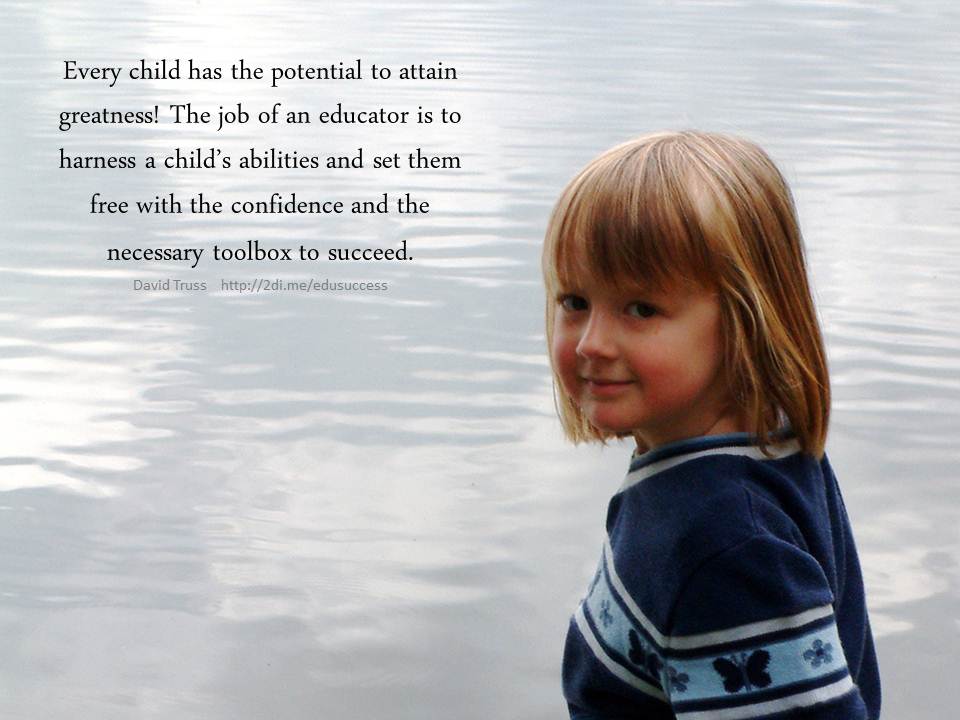
Schools with a strong leadership team, that encourage a meaningful, common vision, can help students perceive learning as a lifelong journey. In doing so, a school must encourage greatness and loathe mediocrity. Educators must maintain high expectations and strive to see students excel. Students must be given the opportunity to maximize their potential and they should be inspired to do so. Every child has the potential to attain greatness! The job of an educator is to harness a child’s abilities and set them free with the confidence and the necessary toolbox to succeed.
Originally posted: May 23rd, 2007
Reflection upon re-reading and re-posting:
In his brief comment on the original post, Harold Jarche said, “I really like your first paragraph. It captures the essence of education.”
That puts technology into perspective! Technology is a tool used to help us get to the goal in the first paragraph. “Do not confuse the pointing finger with the moon.”
|
Tags: community, cooperation, creativity, critical thinking, education, educational philosophy, empathy, Food for Thought, high expectations, leaders, learning, lifelong learning, new literacy, parent involvement, parents, philosophy, relationships, role model, school leadership, success, teachers, teaching, technology, toolbox, vision
Posted in Learning Conversations, Pedegogy, compassion, education, leadership, learning, metaphor, pairadimes, technology | 4 Comments »
Wednesday, April 23rd, 2008
I thought I was going to spend the long weekend reading my book for our book club, but I had a Whole New challenge instead: Putting together a million piece puzzle for my kids to play on in our back yard…. swings, monkey bars, slide, fort, climbing wall, and picnic bench all neatly packed in boxes Ikea style… ’some’ assembly required!
Today I was back at school and boy has reality hit! Tomorrow morning our Grade 8 team has to get the ball rolling for our yearly Renaissance Fair (coming in May); Tomorrow at lunch I start training a Leadership Crew to run a Grade 5 leadership retreat/afternoon at our feeder schools; Some time in the next two weeks I have to set up an afternoon to introduce this program to other middle school leadership teachers/admin; I am running a Pro-D session on ‘Starting Your Own Blog’ a week from Saturday and I still have a number of hours work to do to set things up; I have a sleepover fundraiser at the school in just over two weeks; and my kids are in musical theatre plays (playing at alternating performances) this Thursday & Friday night as well as two shows Saturday… yikes!

And then there is my class Science Alive! wiki. As I said in a comment earlier this week, “I think that I am guilty of seeing the value of using technology in guiding learning, but not effectively guiding learning in my technology use.”
I have done a pretty good job of getting my students going… but now as momentum builds I have come to the realization that I don’t have a marking rubric to guide me, or my students, as we move towards a final product.
My class is assembling a lego model without the instructions, or even the image of the final product on the front of the box. This isn’t a problem for the creative/motivated students; they will assembly a better model in ways that I could never have ‘instructed‘ them… but some students need structure, they have been fed it for years and expect it (even from yours truly – this isn’t finger pointing, it is observation).
I let technology supersede pedagogy.
On the bright side, I am a teacher in my 9th year and I’m loving the vitality and enthusiasm my attempts at a 2.0 Classroom have given me. So what if I am out of my comfort zone, as are some of my students. So what if learning is messy. Of course my approach will be more pedagogically sound next time... but as I start putting all the pieces together, I have come to the realization that some things are worth doing… even if some assembly is required!
Feedback and suggestions for the wiki are invited…
—
Images: 050724006lego05 & 050724007lego06 by quadrapop on flickr.
Originally posted: April 11th, 2007
Reflection upon re-reading and re-posting:
This is the power of a blog… I won’t reflect here, instead I will let the two comments on my original post do that for me. Thanks to Gabriela and Claudia for being so insightful and contributing to my learning!
- – -
Comments
- David, I’ve been reading your posts since I started blogging for my students. I am amazed to see that I share some of your concerns as regards education. Amazed because of the different educational realities we live in and because we teach different subjects.How to deal with “structure dependent” students (most of them) is one of my concerns. They get puzzled when you don’t provide the expected, clear and well organized instructions. I love playing that game, though.I have to admit that I have failed many times. The worst was to feel frustrated and give up. Then I learnt to insist and be patient (both things at the same time). Success is not guaranteed, but when it finally happens the feeling of achievement the students get is so rewarding that it’s worth the “discomfort”. If students have the chance of making decisions, they have an experience and you also have an experience.I had a look at your wiki and I thought: “If I had had a science teacher like him, I would have learnt something at school.”Insist and be patient, and, please, never stay too long in your comfort zone.
Gabriela Sellart on Wednesday, 11 April 2007, 23:28 CEST
- David,I believe there is nothing wrong with needing some structure. It may be a sign of a totally different learning style compared to our own. Let’s say we should learn from it as well. What scientific basis is there to conclude that one style is better than the other?
I would refrain from thinking either that the student in need of “structure” should embrace any other way just because it is better to so many other people. I am sure that by taking part in your wiki, they are already experiencing 2.0 style and, to a certain extent, they must have challenged their previous structures for learning. No need to go over the board with efforts to help. The student can be an expert in his own needs.
Second, I would not try to device any steps to “instruct” these students. Perhaps I am not the best node in these student’s network to go beyond or learn more. Let’s admit it: we are in love not only with what technology enables us to do but also with ‘learning my way’! So I wonder whether I would not create a sense of lack of confidence in those students if I continue to encourage another learning style.
I would definitely help the “structure-needed” student to find a learning node within the wiki members. Peer help will do it. And I would expect that their interaction -unpolluted by my words- teaches me a lesson in learning. As a teacher, I think I would be quite effective if I simply manage to help the student find who can teach/provide the structured view he needs so much.
Look forward to your posts about how your students get on with all this.
It’s a pleasure to see how your wikispaces grow.
|
Tags: assembly, Brian Crosby, classroom2.0, creativity, datruss, David Truss, effective, enthusiasm, Kelly Christopherson, learning, learning is messy, learning2.0, Lego, metaphor, My Web2.0, pair-a-dimes, pedagogy, schools2.0, Science, Science Alive!, teaching, teaching metaphor, technology, web2.0, wiki
Posted in Learning Conversations, Pedegogy, blogging, connecting online, education, instructional design, metaphor, pairadimes, reflection, technology | No Comments »
Tuesday, April 22nd, 2008
My most recent post, “I’m a mop not a sponge” , highlighted a metaphorical epiphany that one of my students had about his learning style. This post will look at metaphors I have found on my journeys through the blogosphere since then.
|
2 rules to my quest:
1. The post title must contain a metaphor.
2. The meaning behind the metaphor has to be worthy of quoting/highlighting/linking to.
|

I’ll start with Lynn losing her glasses. Her Optical Powercut gave her a new perspective on things:
So, what have I learnt? That it’s good to look at things differently sometimes and everyone is much thinner than I thought!!
I think sometimes even ‘rose coloured glasses’ can impair our view of contrasting colours… and ideas!

Moving outward from personal ‘insight’, Carolyn examines classrooms with glass walls , she wonders about the safety of ‘open’ classrooms, but candidly admits,
One of the debates I’ve been having recently has to do with the publicness of learning through 2.0 tools like blogs. Don’t get me wrong. As someone who’s been blogging for almost nine years, and has a dozen different status messages broadcasting my moods & motions 24/7, I’ve set the bar low when it comes to my own privacy.
So we make ourselves ‘open books’ but justifiably worry about how ‘open’ our classrooms have become.
From our classrooms, Pete tells us about our children, The Wolves of Learning,
Our natural curiosity is like a wild animal; it hunts where it needs to in order to satisfy its deep hunger. As children, we awaken each day with an insatiable appetite to learn. It is in our early years that we are “wolves of learning”. There is a deep, DNA-based, natural connection between learning and survival; call it the burning relevance of the empty stomach.
Pete states that institutionalized learning has tamed, “The wildness of our natural curiosity…” and concludes very powerfully,
Let us find ways to give our children back their birthright, their natural curiosity and facility to learn. There have to be ways that we can organize our learning institutions to accommodate individual curiosity and the standardized curriculum. I believe that thoughtful educators can create environments that are less restrictive and provide much more natural habitat for learning. Let us find ways to foster the wildness and thrill of learning again. Let us answer the “Call of the Wild”.
This reminds me so much of the many links I provide in my metaphorically titled Square Peg, Round Hole post, which -each in their own way- comment rather eloquently on the misgivings of our schools… (Note Warlick’s Alien World and the very appropriate Animal School for other meaningful metaphors on this topic.)

And finally on a larger scale Miss Profe notes, in What Really Makes the World Flat, where the most meaningful ‘bridges’ can be made,
Global bridges are important and necessary. But, what about the bridges that can be built between, say, a suburban school and an urban school within the same community? What about making connections between people who can have a real impact on each other and who may be dealing with similar issues? We can visit and meet face-to-face, and see how mutual suggestions are benefiting each other. One does not need a blog or a wiki to do that.

This reminds me of one of my favorite metaphors I use with students, John Heider’s interpretation of Lao Tzu’s Ripple Effect found in The Tao of Leadership
. Our ripples of influence may be far-reaching, but often our greatest influence can be closest to us, where our ripple can be felt most. Miss Profe concludes,
Developing a deeper understanding of one’s community and the people who live there can provide a transformative learning opportunity for students, and in the process, lead to a flatter world in the most profound sense. As we like to say, learning is messy, and there is nothing messier than connecting with The Other within one’s own backyard.
Although I agree with Miss Profe, and value her focus on impacting our own personal communities, I also think that our digital world has made it much easier to have an incredible impact on a global scale.
The world isn’t so much ‘flat’ as it is woven.
…and as I have said before, metaphors teach.
- – - -
Images: Glow by Steve Crane, bifocal by miss oddgers (Karen Rodgers), Celstial Artillery by jpstanley (Jeremy Stanley), Thanks All, you are my favorites by f2g2 (Florian), Divided we fall by mafleen (Kate Robison), Creative Commons by ocean.flynn (maureen Flynn-Burhoe), and CBC ‘Spring Carnival’ detail by Velma’s World (Velma Belchik).
Originally posted: April 8th, 2007
Reflection upon re-reading and re-posting:
It is Miss Profe’s words that are resonating with me now. I have very often felt ‘all alone’ as I embarked on my web2.0 adventure. I have ended up connecting via my blog, and skype, and twitter to teachers in other Provinces, States, and Countries… yet know very little about the things going on in my own district. My outward focus of attention has not been intentional, but rather just ‘easy’.
This is similar to what I have been dealing with as I get used to our new Sharepoint portal. The fact is that the move towards such a portal has been really healthy in promoting the use of online tools into the teaching practice of our district. Alan November has said that ‘we’ are years ahead of other districts. I know this would not have been the case if it were not for the portal. Yet for someone who has been playing with web2.0 tools for a while, the (current) portal tools feel so restrictive and counter-intuitive. We are in the process of upgrading which will change that significantly, but I couldn’t sit around and wait for that to happen.
So for me, it has been easier to ‘go outside’ of the district. However, as more and more teachers ‘get connected’, and as the portal tools become more user friendly, I need to start looking in my own back yard for some meaningful connections.
- – -
Comment from my original post:
My thanks for a thought-provoking post and for sharing my image with your readers. I am analogy-driven, close cousin to metaphor, and I found the points you made compelling. My ‘Spring Carnival’ yarn which you closed your post with is, ironically, not woven but spun. Maybe the world is not just not-flat but is spinning; which begs the question: spinning out of control or just going round-and-round, like a top on it’s axis, like the moon around the earth, like it is supposed to. Cheers!
Velma, COLORBOMB Creations on Monday, 09 April 2007, 00:32 CEST
|
Tags: Carolyn Campbell, creativity, datruss, David Truss, David Warlick, flat world, glass classrooms, John Heider, Lao Tzu, learning, meaning, metaphors, missprofe, pair-a-dimes, Pete Reilly, ripple effect
Posted in Square Peg, books I like, connecting online, learning, metaphor, pairadimes | 2 Comments »
David Truss on Friday, 14 September 2007, 21:46 CEST